
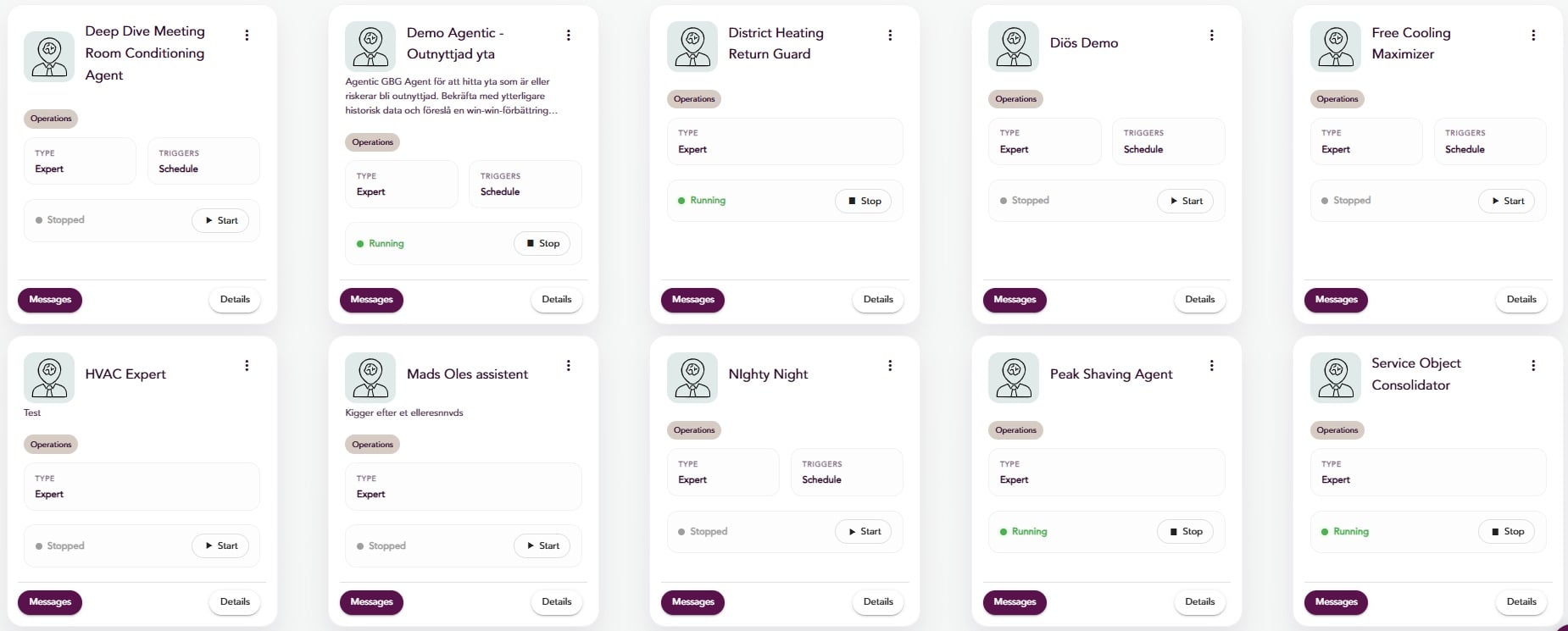
Most real estate teams have more building data than they can act on. Sensors measure. Dashboards display. Alerts fire. But someone still has to notice, investigate, decide, and follow up.
That gap — between data and action — is where buildings waste energy, faults go unresolved, and operational teams burn time on tasks a machine could handle.
AI agents close that gap. Unlike dashboards or analytics tools, agents don’t wait to be asked. They monitor continuously, detect what matters, and execute the next step — adjusting a setpoint, creating a work order, generating a report — within the parameters you define.
Here are 10 building tasks AI agents are handling today.
1. Night setback energy optimization
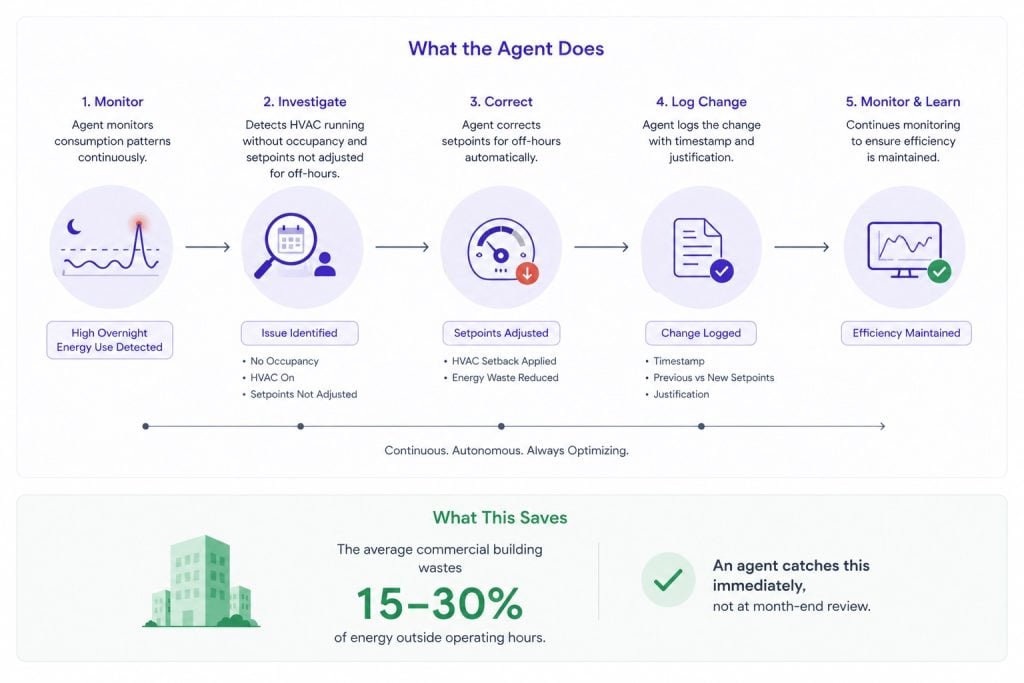
What happens without it: HVAC runs at full operation through the night. No one notices until the energy bill arrives.
What the agent does: Monitors consumption patterns continuously. When it detects high overnight energy use — HVAC running without occupancy, setpoints not adjusted for off-hours — it investigates the schedule, corrects setpoints, and logs the change with a timestamp and justification.
What this saves: The average commercial building wastes 15–30% of energy outside operating hours. An agent catches this immediately, not at month-end review.
2. HVAC fault detection and work order creation
What happens without it: A recurring HVAC fault generates an alert. Someone receives it, checks the BMS, looks up service history, creates a ticket, assigns it, and follows up. That chain takes hours, sometimes days.
What the agent does: Detects the fault, pulls relevant context from the BMS, BIM model, and maintenance history, assesses priority, creates a structured work order, and assigns it to the right team — before a tenant notices the temperature.
What this saves: Faster resolution, fewer repeat faults, and no manual coordination between systems that don’t talk to each other.
3. CO₂ and indoor air quality management
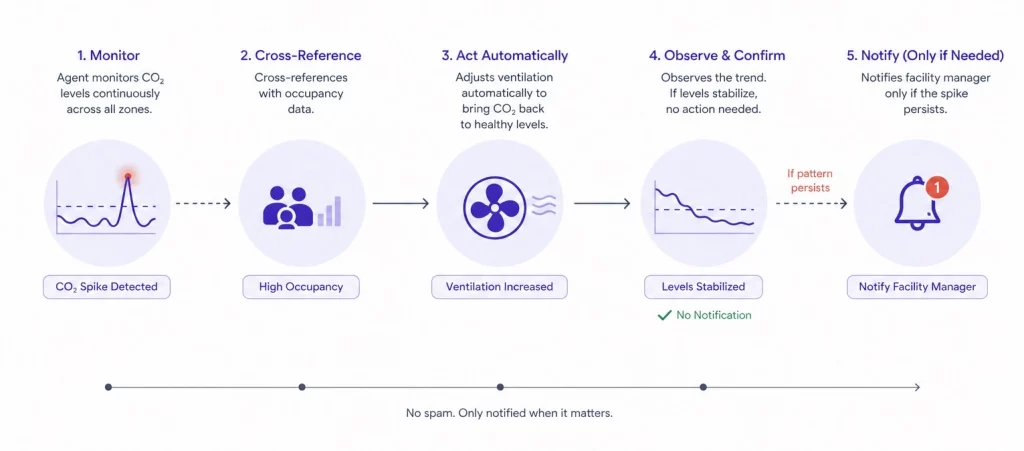
What happens without it: CO₂ builds up in a meeting room. Productivity drops. Someone eventually opens a window or submits a complaint.
What the agent does: Monitors CO₂ levels continuously across zones. When a spike is detected, it cross-references occupancy data, adjusts ventilation automatically, and notifies the facility manager only if the pattern persists — not for every single reading.
What this saves: Complaints that never get submitted because the problem is resolved before it’s noticed. Better cognitive performance for occupants. Lower unnecessary ventilation energy costs during empty periods.
4. Water leak detection
What happens without it: A slow leak runs for days or weeks. The first sign is visible damage or an unexplained spike in the monthly water report.
What the agent does: Monitors meter data in real time. Abnormal usage patterns — consumption during non-operating hours, flow rates that don’t match occupancy — trigger an alert before damage escalates. The agent creates a maintenance task with location data attached.
What this saves: Water damage is one of the most costly building incidents. Early detection by agents reduces both physical damage and insurance exposure.
5. Temperature deviation correction
What happens without it: Rooms drift from their setpoints. Complaints come in. A facility manager manually investigates which zone, which controller, which schedule.
What the agent does: Continuously compares actual temperature readings against setpoints across every zone. When a room diverges beyond a defined threshold, it identifies whether the issue is a schedule problem, a sensor fault, or a controller error, adjusts what it can, and escalates what it can’t.
What this saves: Comfort complaints cost more to handle reactively than to prevent. Agents catch deviations before occupants do.
6. ESG and energy compliance reporting
What happens without it: A sustainability officer manually pulls data from multiple systems, reconciles it, formats it, and produces a report — quarterly or annually, under deadline pressure.
What the agent does: Aggregates consumption data across meters, floors, and assets continuously. Benchmarks performance against targets (GRESB, CSRD, BREEAM, internal KPIs). Flags anomalies when a building is trending off-target. Generates the report automatically.
What this saves: Weeks of manual work per reporting cycle. Fewer errors from manual data reconciliation. Earlier warning when a building is trending away from targets — not a surprise at year-end.
7. Predictive maintenance scheduling
What happens without it: Maintenance follows a fixed calendar — annual inspections, scheduled replacements — regardless of actual equipment condition. Some assets fail early. Others get serviced when they didn’t need it.
What the agent does: Tracks runtime hours, performance signals, and deviation patterns for key equipment. When condition data suggests a component is approaching failure, it schedules maintenance at the optimal time — not too early, not too late.
What this saves: Unplanned equipment failure costs 3–9x more than planned maintenance. Agents shift buildings from reactive to predictive operations without requiring manual monitoring.
8. Occupancy-based space adjustment
What happens without it: An entire floor is lit and climate-controlled for four people in the corner. The rest is empty.
What the agent does: Reads occupancy sensor data across zones and adjusts HVAC, lighting, and ventilation per zone based on actual use. An empty floor runs at reduced settings. A suddenly full conference wing gets pre-conditioned before the meeting starts.
What this saves: 20–30% of conditioning energy in office buildings goes to unoccupied spaces. Agents reduce this without requiring manual overrides.
9. Tenant comfort monitoring
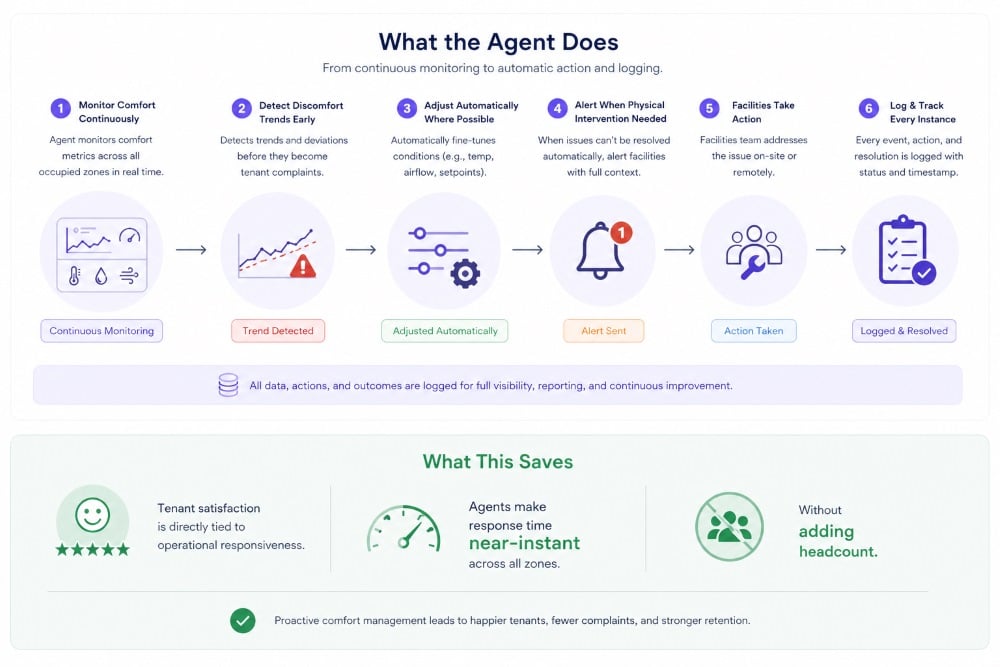
What happens without it: Tenants experience discomfort — too hot, too cold, poor air quality. Eventually they submit a complaint or, worse, mention it in a lease renewal conversation.
What the agent does: Monitors comfort metrics continuously across occupied zones. Detects discomfort trends before they become complaints, adjusts conditions automatically where possible, and alerts facilities when physical intervention is needed. Logs every instance with resolution status.
What this saves: Tenant satisfaction is directly tied to operational responsiveness. Agents make response time near-instant — without adding headcount.
10. Operational follow-up and documentation
What happens without it: An issue is raised. It gets assigned. Somewhere in the chain, follow-up falls through. Three weeks later: the same fault, the same alert, the same conversation.
What the agent does: Tracks every open issue from detection through resolution. Sends reminders, escalates unresolved items after defined time windows, and documents outcomes. Every action — detection, decision, resolution — is logged with a timestamp.
What this saves: The hidden cost of operational gaps isn’t just the individual issue. It’s the cumulative effect of problems that recur because no one confirmed they were closed.
What These Tasks Have in Common
Each one involves the same pattern: monitor a data stream, detect a deviation, apply context, take or trigger an action, log the outcome.
That pattern doesn’t require a human — it requires a connected data foundation and an agent configured to act within defined parameters.
What it does require is that your building data is accessible, structured, and connected across systems. AI agents work on top of a data layer. Without one, there is nothing to monitor.
How ProptechOS enables Agentic Operations
ProptechOS connects your building systems — BMS, IoT sensors, meters, BIM, service platforms — into a unified data layer. Agents are configured through the platform, not code. Every action is logged, every threshold is configurable, and human override is always available.
Teams typically start with energy optimization and HVAC fault detection, then expand as more systems come online. Agents improve as more data becomes available.
37% of everything real estate companies do can be automated today. — Morgan Stanley, 2025
The question isn’t whether AI agents will become standard in building operations. It’s how quickly your data infrastructure is ready to support them.
See how ProptechOS enables agentic operations
Frequently asked questions
Do AI agents require coding to set up?
No. ProptechOS agents are configured through the platform. Custom agents can be built by developers if needed, but standard use cases are available without code.
Can agents take actions without human approval?
You choose. Agents can operate in suggestion mode (recommendations only), approval mode (actions require sign-off), or autonomous mode (act within defined parameters). Every action is logged regardless of mode.
What building systems do agents need to connect to?
The most common starting points are BMS, energy meters, and IoT sensors. ProptechOS connects to 200+ systems and vendors via pre-built connectors.
Will AI agents replace facility management staff?
No. Agents handle repetitive monitoring and response tasks so facility teams can focus on decisions that require human judgment — tenant relationships, capital planning, complex fault resolution.
How long does it take to get agents running?
Most teams have their first agents active within the first weeks of onboarding, typically starting with energy monitoring and HVAC deviation detection.
