
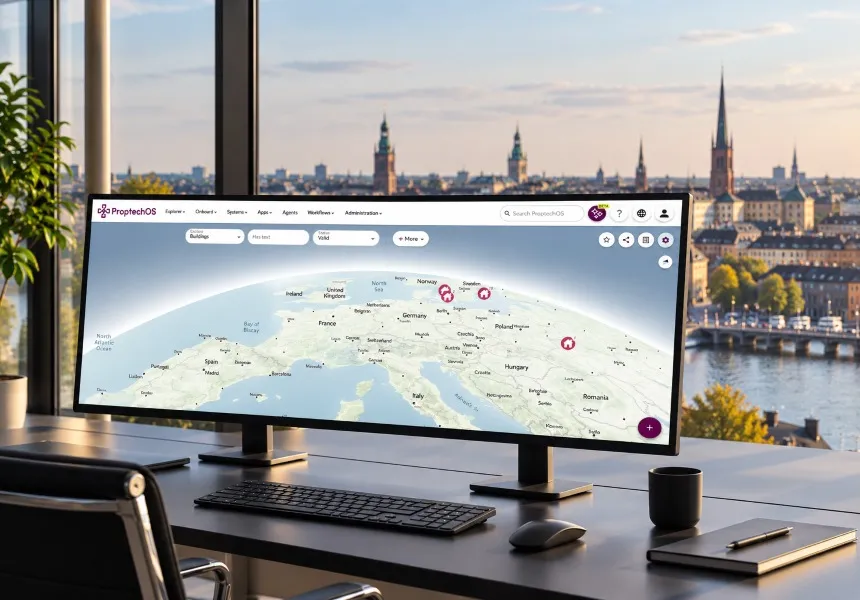
European real estate owners are no longer short on building data. Most portfolios already have a building management system in every major asset, metering on the main supplies, IoT sensors in the flagship buildings, and at least one analytics dashboard. What they lack is a reliable way to turn that data into action across dozens or hundreds of buildings, each with different systems, vendors and naming conventions.
That is the gap agentic building operations is designed to close. Instead of adding another dashboard that someone has to watch, AI agents monitor building systems continuously, decide what needs attention, and act, or recommend action, within boundaries the owner defines.
For European portfolios specifically, the case is sharper than elsewhere. Regulatory pressure on energy performance, sustainability reporting and AI governance is converging, and portfolios spread across several countries face all of it at once.
What agentic building operations means
Agentic building operations is an operating model where AI agents take on defined operational tasks in buildings: detecting deviations, diagnosing causes, adjusting setpoints, creating work orders, and verifying that fixes worked. Humans set the goals, the rules and the permissions. Agents do the continuous, repetitive work at portfolio scale.
The simplest way to understand the shift is the difference between a system of record and a system of action.
A system of record stores and displays what is happening. Most building analytics platforms sit here: they collect data, visualise it and raise alarms. The value depends entirely on someone noticing, interpreting and responding.
A system of action closes the loop. It connects the data to decisions and the decisions to outcomes, and it records what was done and why. Agentic operations moves buildings from the first model to the second, which is why it depends on a building operating system rather than another analytics layer. For a fuller breakdown, see what an AI building operations platform is.
Why European portfolios face a different problem
Fragmented technology across countries and assets
A typical pan-European portfolio has grown through acquisition. A Stockholm office, a Berlin logistics hub and a Madrid retail asset will usually run different BMS brands, different integrators and different point-naming standards. Any automation that depends on per-building configuration breaks down long before it reaches portfolio scale.
This is why a common data model matters more in Europe than in single-market portfolios. Agents can only act consistently across buildings if they understand every building in the same terms.
Regulation is moving from reporting to performance
Three regulatory streams are shaping how European owners operate buildings.
The Energy Performance of Buildings Directive (EPBD) recast raises expectations for building automation and control systems in larger non-residential buildings and pushes the stock toward zero-emission performance over the coming decades. Owners need systems that do more than log energy use; they need systems that actively control it, which is the shift behind commercial real estate energy management.
Sustainability reporting under CSRD and the EU Taxonomy has required owners to produce defensible data on energy and emissions. Even as the scope of these rules has been adjusted, investors and lenders continue to ask for the same evidence. Data that is estimated, inconsistent or manually compiled is increasingly hard to defend.
The EU AI Act introduces obligations around transparency, human oversight and risk management for AI systems. Any AI that acts on physical infrastructure needs to be explainable, governed and auditable from day one, not retrofitted later.
Together, these mean European owners cannot treat AI in buildings as an experiment. It has to be operationally effective and governable at the same time.
Lean operations teams, growing portfolios
Facilities teams are rarely growing at the pace of portfolios. A technical manager covering a dozen buildings cannot review every alarm, trend log and deviation. Most issues are found late, if at all: simultaneous heating and cooling, schedules that drifted after a tenant change, valves stuck open for months.
Agents change the ratio. They review every signal in every building, every hour, and bring people only the decisions that need them. That is where most of the operational efficiency gains come from.
How agentic building operations works in practice
A shared semantic model of the portfolio
Everything starts with a model that describes each building consistently: spaces, equipment, sensors, and how they relate. ProptechOS builds on RealEstateCore, an open-source ontology for real estate, so every building in the portfolio is described in the same language regardless of the underlying BMS vendor. The result is a digital twin of each asset that agents can reason over, connected to existing systems through standard connectors.
For agents, this is the difference between understanding “AHU-02 supply air temperature on floor 4, serving these zones” and seeing an anonymous data point called B4_AHU2_SAT_PV.
Agents with defined roles
Not every task should be handled the same way. A practical agent architecture, like the one behind ProptechOS Agency, separates roles by what they are allowed to do:
- Oracle agents answer questions about the portfolio using live and historical data, such as which buildings exceeded their energy baseline last month and why.
- Expert agents diagnose problems and recommend actions, applying domain knowledge about HVAC, energy and indoor climate.
- Embodied agents interact with building systems directly, adjusting setpoints or schedules within approved limits.
- Task runners execute defined workflows end to end, such as creating a work order, notifying the service partner and verifying the result.
Separating roles makes it easier to decide where autonomy is appropriate and where a human must stay in the loop.
Governance built into the architecture
For European owners, governance is not a policy document that sits beside the system. It has to be enforced by the system itself.
That means agents operate with zero standing privileges: they receive only the permissions needed for a specific task, for a limited time, and those permissions are revoked afterwards. Every action is logged with the data that triggered it, the reasoning applied and the outcome. Owners decide which actions agents can take autonomously, which require approval, and which are off limits entirely.
This is what makes agentic operations compatible with the transparency and human-oversight expectations of the EU AI Act, and what makes it acceptable to risk, IT and asset management teams.
Closing the loop with verification
An action is not finished when a setpoint changes. Agents check whether the change produced the intended result: did the zone reach its temperature, did energy use drop, did the deviation stop recurring? If not, the issue is escalated. Verification is what turns automation into measurable performance improvement.
Example: deviation control across a multi-country portfolio
Consider a portfolio of office buildings across the Nordics and Germany. Every night, agents compare actual operation against intended operation in each building, an approach covered in more depth in IMD deviation control.
In one Gothenburg asset, the agent detects that ventilation has been running at full capacity through weekends since a tenant moved out. It checks the occupancy data, confirms the floor is vacant, and identifies the schedule as the cause. Because schedule adjustments within defined ranges are pre-approved, it corrects the schedule, logs the change, and confirms on Monday morning that the weekend runtime dropped.
In a Munich asset, a different agent finds a chiller cycling abnormally. That is outside its approved scope, so it creates a work order with the diagnosis, supporting trends and suggested next steps, and routes it to the service partner.
The technical manager sees both in a single review: one resolved and verified, one waiting for action with everything needed to act on it. For real-world results, see our case studies.
What portfolio stakeholders gain
Facilities and operations teams spend less time searching for problems and more time fixing the ones that matter. Deviations are found in hours rather than months.
Energy and sustainability leads get continuous control over energy performance rather than retrospective reporting, and data that is traceable to its source. The Energy Toolbox is a practical starting point.
Asset and portfolio managers get comparable performance across buildings and countries, supporting valuation, capex planning and investor reporting. You can estimate the effect on your own assets with the NOI calculator.
Technology leaders get an open, standards-based architecture that avoids vendor lock-in and works with existing BMS investments, with security and governance they can audit.
Commercial and leasing teams get evidence of indoor climate and sustainability performance to support tenant retention and green lease conversations.
Getting started: a practical path
Agentic operations does not require replacing existing systems. A realistic rollout for a European portfolio looks like this (see how it works for the technical detail):
- Start with a representative set of buildings. Choose three to five assets across different countries and BMS vendors to prove the model scales across the portfolio’s real diversity.
- Model the buildings semantically. Map systems, equipment and points to a common ontology so agents can reason consistently.
- Begin with observation and recommendation. Let agents detect and diagnose before they act, building trust and establishing a baseline.
- Grant autonomy by exception. Approve low-risk, reversible actions such as schedule and setpoint corrections first, and expand scope as results are verified.
- Scale by template, not by project. Once the model and governance rules work, extend them to the rest of the portfolio without rebuilding per building.
When you’re ready to scope a pilot, the getting started guide walks through the first steps.
Why this matters now
European portfolios are being asked to deliver better energy performance, stronger evidence and responsible AI, all with operations teams that are not getting bigger. Dashboards alone cannot close that gap, because they still depend on people to notice and act.
Agentic building operations turns the data owners already have into continuous, governed action. For portfolios operating across multiple countries, systems and regulatory regimes, that combination of scale, consistency and control is what makes it practical. Read more on how agentic proptech is reshaping the wider industry.
Frequently asked questions
What is agentic building operations?
Agentic building operations is an approach where AI agents continuously monitor building systems, diagnose issues and take or recommend actions within limits set by the building owner. It moves buildings from passive monitoring to active, verified operation.
How is it different from traditional building analytics?
Traditional analytics platforms show data and raise alarms, but people still have to interpret and act. Agentic operations closes the loop by deciding what to do, acting within approved permissions and verifying the outcome.
Does agentic building operations require replacing the existing BMS?
No. Agents work on top of existing building management systems by connecting to them through a common semantic data model, so owners can keep their current investments across vendors and countries.
How does it relate to the EU AI Act?
AI that acts on physical infrastructure needs transparency, human oversight and auditability. A well-designed agentic system enforces these through scoped permissions, approval rules and a full log of every action and the reasoning behind it.
Can agentic operations support EPBD and sustainability reporting?
Yes. Agents actively control energy performance rather than only recording it, and every action and outcome is traceable to source data, which supports energy performance goals and defensible reporting.
Where should a European portfolio start?
Start with a small, representative set of buildings across different countries and BMS vendors, begin with detection and recommendations, and expand agent autonomy as results are verified.
