Calculate your proptech boost!

AI Agents for Real Estate

Turn building data into consistent action – automatically.

AI agents help real estate teams move beyond dashboards and manual follow-up. They monitor buildings continuously, detect what matters, and trigger the next step across energy, indoor climate, HVAC, water, and operations.


Less noise. Faster response. Scalable execution.

The challenge

Most real estate portfolios already have data. BMS signals, energy systems, sensors, reports, alerts and dashboards. 

But when something happens:

  • Someone has to notice it
  • Someone has to check context in another system
  • Someone has to decide what to do
  • Someone has to follow up and document it


This manual stitching is where time, consistency, and operational capacity disappear. The problem is rarely the lack of data, it is the gap between detection and action. 

The AI agent approach

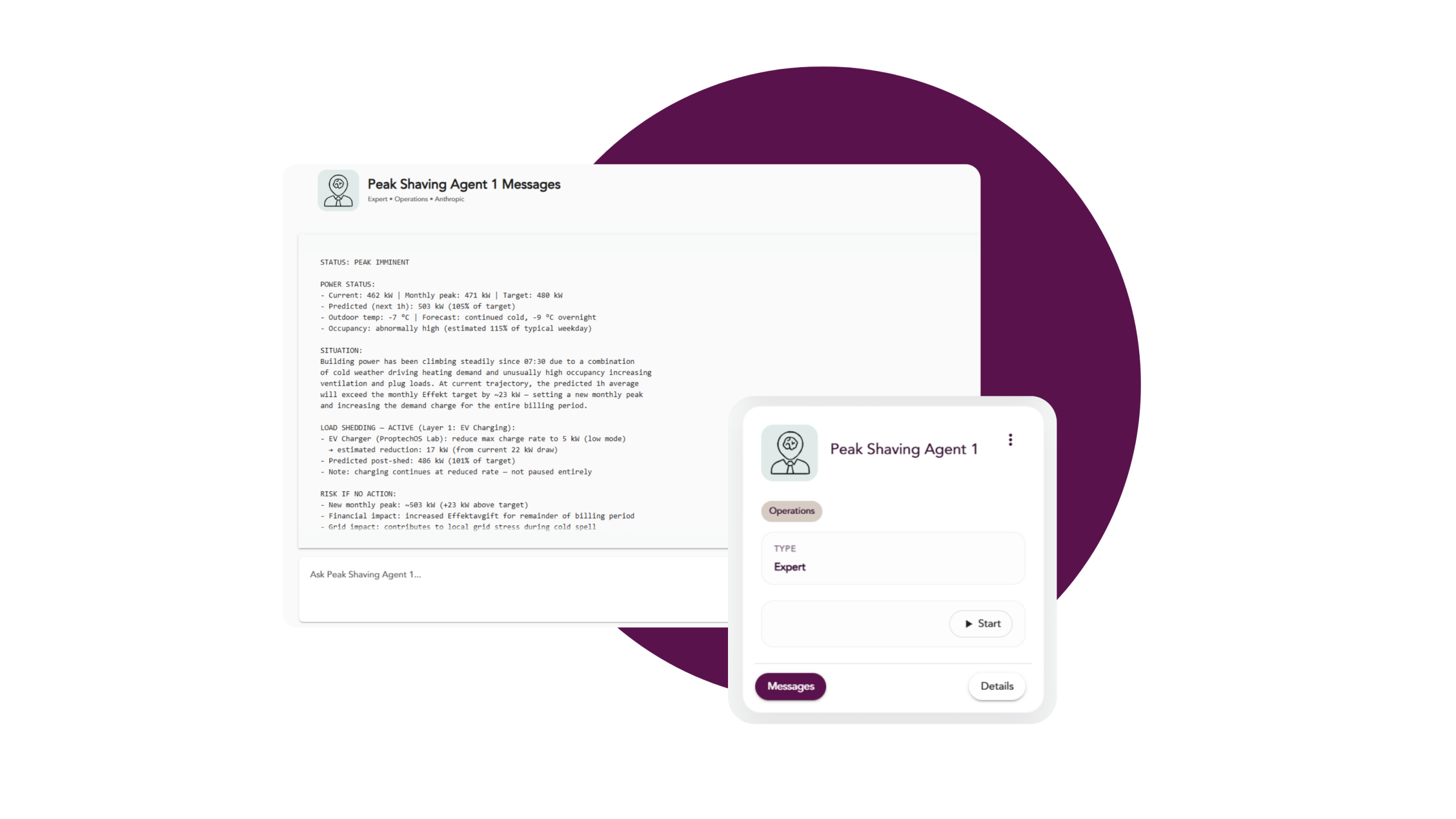
AI agents act like digital operators inside ProptechOS.

Instead of continuously watching dashboards, teams configure agents that:

  • Monitor data across buildings and portfolios
  • Detect deviations, risks, and inefficiencies
  • Apply context to decide what matters
  • Trigger checks, recommendations, or escalations
  • Log outcomes for transparency and compliance


Instead of waiting for someone to react, agents act continuously in the background. But agents do not replace people, they reduce repetitive monitoring so teams can focus on decisions. 

What AI agents handle today

Energy optimization

Identify waste, night setback issues, and inefficient control strategies across portfolios.

Indoor climate monitoring

Detect temperature, CO2, and comfort deviations before tenants complain.


HVAC deviation detection

Find rooms and zones where actual performance does not match setpoints.

Water leak detection

Spot leaks and abnormal usage early using meter data patterns.

Operational follow-up

Ensure issues are routed, handled, and documented consistently.


Designed for human control

AI agents do not replace people. They remove manual overhead.

You decide:

01

Which data agents can access

AI agents only work with the data you explicitly connect and allow.

This typically includes:

  • BMS and HVAC signals (setpoints, temperatures, alarms)
  • Energy, water, and meter data
  • Indoor climate and occupancy data
  • Asset, space, and building context


Agents do not scrape or guess. They operate within defined data boundaries per building, portfolio, or use case.

02

Which rules and thresholds they follow

Agents act based on clear, configurable logic.

You define:

  • Comfort ranges and performance thresholds
  • Energy and usage limits
  • Time schedules (day, night, weekends)
  • Exception rules per building or asset type


This ensures agents behave consistently with your operational standards and policies.

03

When actions are automatic and when approval is required

Automation is optional and progressive.

You decide:

  • Which actions run fully automatically
  • Which actions require human approval
  • Which situations only trigger alerts or recommendations


Many teams start with decision support and move to automation once trust is established.

04

How results are logged and reported

Every agent action is documented.

Agents:

  • Log what was detected
  • Record which rule was applied
  • Track what action was taken (or not taken)
  • Store outcomes for reporting and audits


This creates transparency, accountability, and a clear operational history across the portfolio.

Built to evolve with your portfolio

AI agents depend on available data. The more systems connected, the more valuable the outcomes become. Many teams start with; basic indoor climate monitoring and/or daily building summaries, then expand as more sensors and systems are onboarded. Agents are continuously improving, and new expert capabilities are added over time.

The outcome

Control does not disappear – it scales.

AI agents reduce manual work while preserving oversight, traceability, and governance across buildings and teams.

The result

  • Faster response to issues

  • Fewer manual tasks

  • More consistent operations

  • Better energy and comfort outcomes

  • Scalable control across portfolios

From insight to action – without adding complexity.

See AI agents in action

Explore how AI agents work across real estate operations, from detection to execution.