

Most office buildings already generate more occupancy signal than anyone uses. CO2 sensors, Wi-Fi counters, badge taps, booking calendars — the readings exist, updating in real time, and in most portfolios they still only answer one question: what happened yesterday. The more useful question is what a building could do if that data moved from the rearview mirror to the steering wheel.
Occupancy is not the same as utilization
Two rooms with 16 people in them can tell completely different stories. In a room designed for 16, that is full utilization. In a room designed for 160, it is 10 percent. Occupancy tells you whether someone is there. Utilization tells you how well the space is being used relative to what it was built for. Flow tells you how people move between spaces once they are occupied.
The distinction matters because most sensor data was never built to answer it. A presence sensor reports a binary in-or-out. Getting to utilization means adding context the sensor never had — how big the room is, what it was designed for, who is allowed to be there — and that context is exactly what a shared data model like RealEstateCore is for.
The sensors are usually already there
A useful starting inventory is longer than most teams expect: CO2 levels, occupancy-aware lighting, Wi-Fi and Bluetooth device counts, badge events, door status, BMS ventilation load, water consumption, booking calendars, and — increasingly, as the EU’s EPBD pushes indoor climate monitoring into larger buildings — VOC and humidity sensors. Even facilities tickets and out-of-hours service logs carry a signal. None of these were installed to measure occupancy, but nearly all of them correlate with it. A room’s CO2 rises within minutes of people entering it. A lighting system with occupancy-aware fixtures already knows where people sat during the day. A badge tap tells you who is in the building without a single presence sensor in the ceiling.
The practical implication is that a portfolio rarely needs new hardware to start. It needs the signal it already has connected into one model that can reconcile it. The bottleneck is usually half a dozen systems that were never built to talk to each other, not a shortage of underlying data.
Why the sensor layer should not be the foundation
Sensor vendors come and go. One well-known IoT sensor brand went bankrupt within a few years of a hype cycle that made it look permanent, and buildings that had wired their systems directly to its API lost access to their own historical readings along with it. Building on a shared ontology instead of a single vendor’s API means the underlying sensor can be replaced without the building losing its history — and it opens the door to virtual sensors: estimating occupancy from a room’s CO2 curve when there is no dedicated presence sensor at all, trading a little precision for coverage across an entire portfolio instead of just the rooms that got the expensive hardware.
Five stages, from measuring to acting
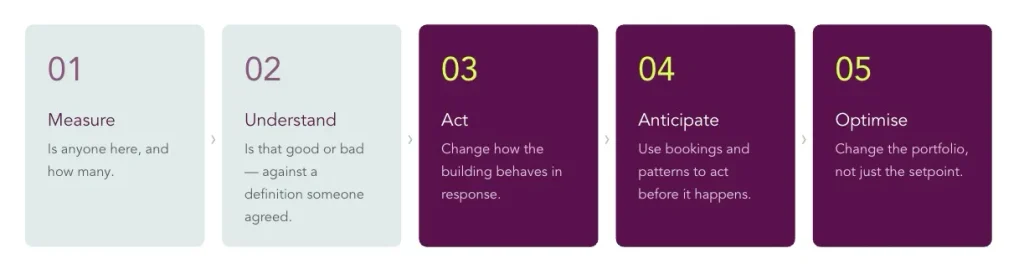
A useful way to sequence this work is measure, understand, act, optimize, anticipate.
- Measure covers raw presence and count signals, reconciled across whatever sources exist.
- Understand turns that raw signal into KPIs that mean something against a policy — occupancy rate, peak utilization (some buildings have logged over 100 percent once common areas fill up), no-show rate on room bookings.
- Act is where an agent starts doing something with the pattern instead of only reporting it: releasing a meeting room that was booked but never occupied, shutting down an entire floor overnight instead of conditioning a half-empty building, or triggering cleaning only where a space was actually used rather than on a fixed schedule.
- Anticipate predicts demand before it happens: once a system has a sense of who is likely to be in the building on a given day, based on role or past pattern, it can prepare space ahead of time instead of adjusting after the fact.
- Optimize adjusts the underlying policy once the pattern is clear — consolidating a hybrid-work schedule around the days people actually come in, or matching desk types to how different teams actually work.
Most portfolios today are still stuck at measure — dashboards describing what happened last week. The step that changes the economics is act and optimize, because that is where reporting turns into decisions: shrink a leased footprint, renegotiate a tenant’s space, cut a fifth day of building operation, or stop cleaning and conditioning rooms nobody used.
What is actually at stake
One occupancy-sensor vendor’s own data, drawn from a large sample of offices, put realized occupancy at 20 to 30 percent of available desks — lower than most facility teams would guess. If even part of that gap is structural rather than seasonal noise, it shows up directly in a portfolio’s cost base: unused square meters still carry tax, cleaning, heating and maintenance costs whether or not anyone sits in them. Space consolidation driven by this kind of data is not hypothetical. It changes lease decisions, tenant pricing, and which floors get renovated first.
The starting point is whatever signal a building already has — CO2 readings, badge taps, existing BMS data — reconciled into one model that can define what “utilized” actually means for that space. From there, routine decisions such as releasing a room, adjusting ventilation, or flagging a floor worth shutting down can move from a spreadsheet to an agent that acts on the pattern directly.
