
AI for real estate. Built to create intelligence you can act on.
Most real estate portfolios are already digital, but their data is fragmented across disconnected systems. The challenge isn’t access to data, it’s turning it into answers without friction. Information lives in silos, follows different standards, and still requires manual work to produce insights, reports, and decisions.
ProptechOS removes that friction by harmonizing all real estate data into a single operational platform. Instead of navigating systems or rebuilding logic, you ask once and act with confidence, grounded in consistent, trusted data. ProptechOS acts as the operating system for real estate. AI is the layer that turns structured data into action.












ProptechOS – an operating system for real estate.
AI built in to turn connected data
into answers, tools, and action.
What generative proptech actually is
With ProptechOS as the operating system, generative proptech turns connected real estate data into usable outputs on demand. Those outputs are not generic content, they are the operational artefacts real estate runs on.
Within ProptechOS, AI can generate:
- Reports, summaries, and narratives generated directly from portfolio data
- Dashboards and lightweight apps assembled on the fly from prompts
- Tenant, investor, and stakeholder communication tailored to context and audience
- Meeting notes, action lists, and follow-ups grounded in live building data
- Policies, templates, and procedures aligned with your assets and rules
- Specifications, requirements, and briefs generated from actual conditions
In short, generative proptech minimises the distance between data and work.

From connected data to a building that can answer
For AI to work in real estate, data must be understandable, structured, and consistent.
Generative proptech depends on a data foundation where:
- All building systems speak the same semantic language
- Assets, spaces, meters, and equipment are modeled consistently
- Relationships between data points are explicit, not inferred
- Context is always available to the AI, not reconstructed manually
This is why open standards matter.
With ProptechOS, data is harmonized using open standards like RealEstateCore and exposed through the Model Context Protocol, (MCP). ProptechOS exposes structured building context, allowing AI agents to understand what a building is, how it is structured, and how its data relates.
As a result, you can ask real questions, not predefined queries. ”Which rooms are free right now?”, “Why did energy consumption increase last week?”, “Where are comfort issues emerging across the portfolio?” The AI pulls the right data, builds the right view, and gives a clear, visual answer.
Commoditising knowledge work in real estate
Real estate has spent decades optimising physical assets. Knowledge work has barely changed.
Teams still spend time:
- Pulling data from multiple systems
- Translating metrics into different stakeholder narratives
- Rewriting similar reports month after month
- Maintaining documentation that is outdated the moment it is published
- Responding to questions without full portfolio context
Generative proptech commoditises this work. Recurring outputs become cheap, repeatable, and prompt driven. The effort shifts from producing material to deciding what to do with it. Monthly reporting becomes a prompt, not a project. Asset narratives are generated, not rewritten. Internal tools are created when needed, not specified months in advance.

Built for real estate operations
Generative proptech is not limited to text, it is also a way to create simple internal software without long projects or specialist teams.
With AI developed apps, teams can generate:
- Custom dashboards and portfolio views
- Small workflow apps for checks and approvals
- Data entry helpers and validation flows
- Templates that enforce internal standards
- Prototypes in days instead of quarters
This removes two long-standing constraints in real estate. Teams rarely built their own tools. Analytics projects took too long to deliver value. Generative proptech removes both.
AI powered apps vs AI developed apps
Built on top of the ProptechOS operating system, AI developed apps are created through conversation.
AI powered apps are traditional applications with intelligence added on top. They improve incrementally but remain fixed in scope.
AI developed apps are created through conversation. Non-experts describe what they need, and AI produces production-ready outputs grounded in real estate data, structure, and rules.
In this model, prompts become critical IP. Prompts encode domain expertise, workflows, and standards. They improve over time and compound in value. Platforms, like ProptechOS, that combine high-quality real estate data with a strong developer and AI environment are uniquely positioned to lead this shift.
From generative to agentic, by design
Generative proptech focuses on creating understanding. Agentic proptech focuses on execution. Both layers rely on the ProptechOS operating system as their foundation.
They share the same foundation:
- Clean, well-modeled data
- Clear permissions and access control
- Explicit workflows and rules
Generative outputs come first, agents build on top when organisations are ready. This sequencing is what makes AI safe, auditable, and valuable in real estate.
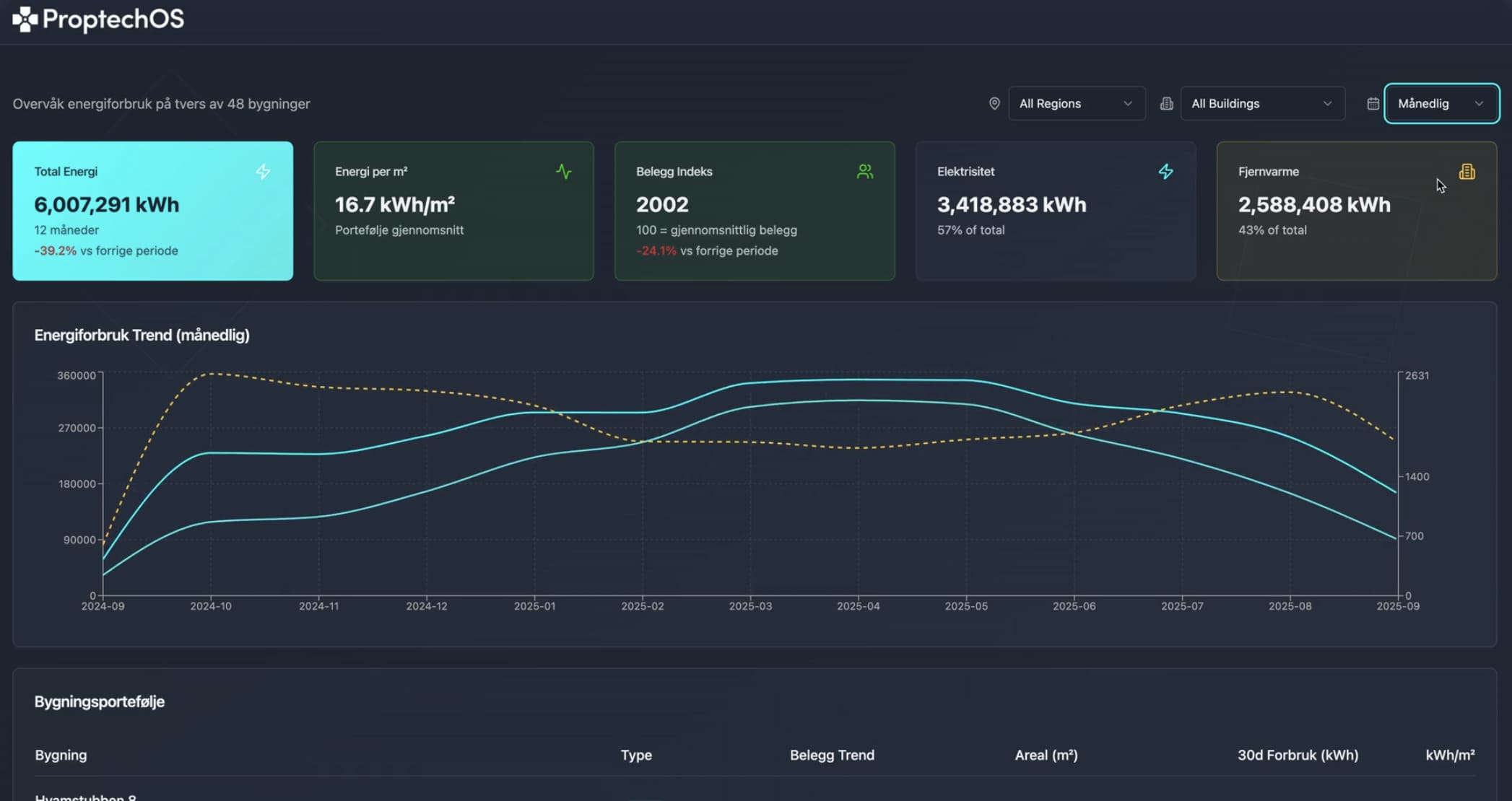
What you can generate from connected building data
Generative proptech is the ability to turn portfolio and building data into operational outputs on demand. These outputs are not generic text. They are the artefacts real estate actually runs on. Reports, summaries, and narratives generated directly from live portfolio data. Dashboards and portfolio views assembled from prompts. Tenant, investor, and stakeholder communication tailored to context and audience. Meeting notes, action lists, and follow ups grounded in live building signals. Policies, templates, and procedures aligned with your assets and internal rules. Specifications, requirements, and briefs generated from actual building conditions. In short, generative proptech reduces the distance between data and work.
For this to work, the building itself must be able to answer. AI only becomes reliable when data is understandable, structured, and consistent. Generative proptech depends on a foundation where assets, spaces, meters, and equipment are modelled consistently. Relationships between data points are explicit rather than inferred. Context is always available to the AI, not reconstructed manually. Permissions and provenance are clear, so every output is auditable.
This is why open standards matter. ProptechOS harmonises data using open standards such as RealEstateCore and exposes it through Model Context Protocol, MCP. This allows AI assistants and agents to understand what a building is, how it is structured, and how its data relates. As a result, questions become practical rather than theoretical. Which rooms are free right now. Why did energy consumption increase last week. Where are comfort issues emerging across the portfolio. The AI pulls the relevant data, assembles the right view, and returns a clear answer with the right context.
Why platforms matter
AI acts as a multiplier. It increases the output of teams, which increases the value delivered to customers, who in turn benefit from the same multiplier. For platforms, this effect compounds.
As software becomes easier to generate, value shifts away from individual vertical apps toward platforms that:
- Model the real world correctly
- Expose data and context safely
- Enable AI to reason, generate, and act
Generative proptech is not about replacing people or systems, it is about removing friction between insight and execution.
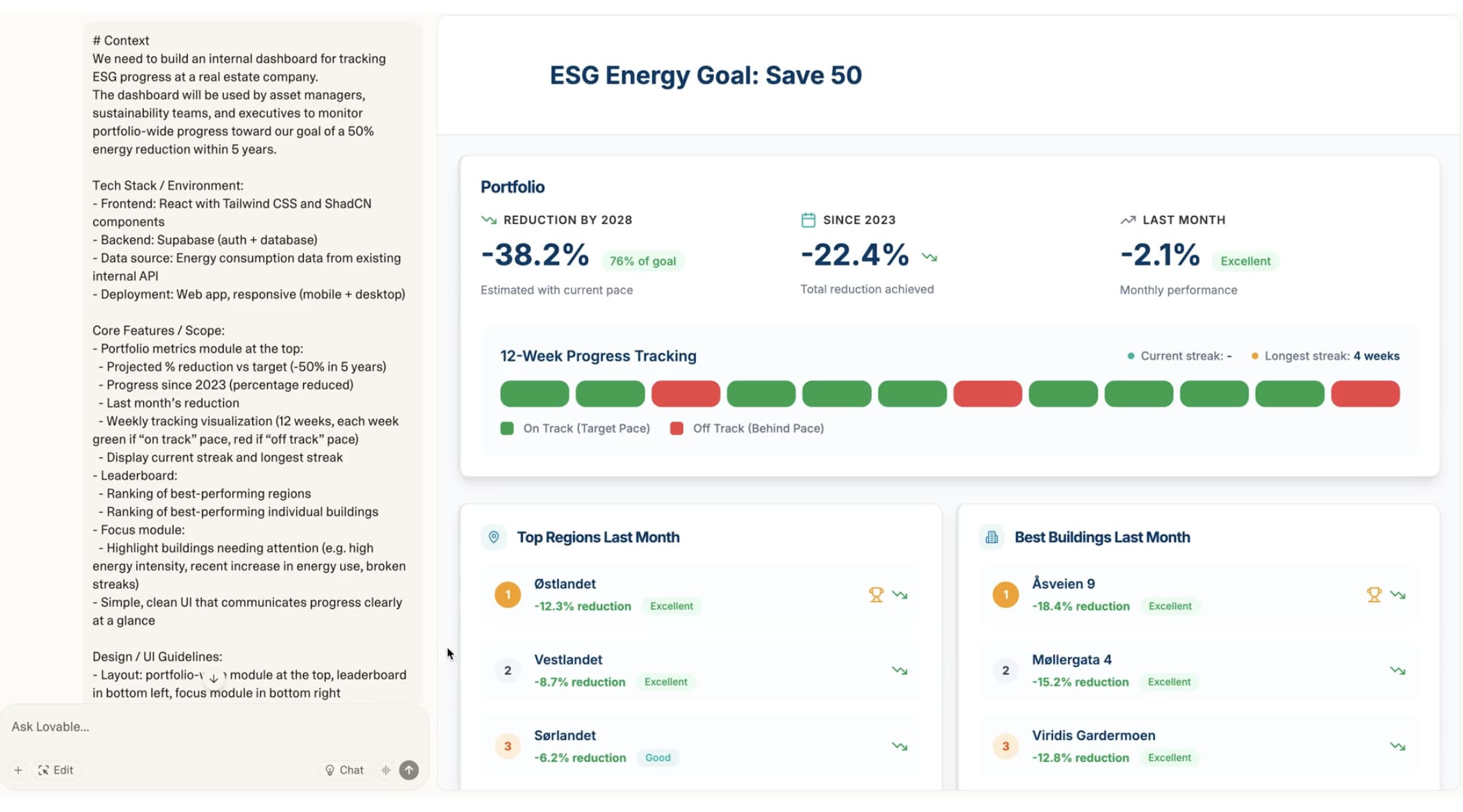
From idea to prototype in 24 hours
Generative proptech is best understood by building, not explaining.
In our 24-hour AI hack workshop, teams move from a real operational problem to a working AI prototype in a single day. Together, we connect the right building data, define context and prompts, and generate AI-developed apps, dashboards, or assistants grounded in ProptechOS.
You leave with a functioning prototype, not a concept. No long specifications. No months of implementation. Many of the workflows customers use in production today started as 24-hour prototypes. Generative proptech compounds with use. The faster you build, the faster it delivers value.
Do you have any questions?
What is generative proptech?
Generative proptech is the ability to turn connected real estate data into useful, on-demand operational outputs using generative AI. These outputs aren’t generic content, they are the artefacts real estate teams actually use – like reports, dashboards, communication, templates, and workflow tools – all grounded in live portfolio data
How does generative proptech work with my building data?
For generative proptech to work reliably, your data must be structured, consistent, and understandable to AI. That means assets, equipment, spaces, and relationships must be modelled clearly (often via open standards like RealEstateCore) so AI can interpret context and return practical answers to real questions about your portfolio.
What kinds of outputs can generative proptech create?
Generative proptech can produce things you’d normally spend hours creating manually, such as:
Portfolio and asset reports, summaries, and narratives
Dashboards and visual views assembled on the fly
Stakeholder communication tailored to context and audience
Meeting notes, action lists, and follow-ups grounded in building signals
Policies, requirements, briefs, and internal templates tied to your assets and rules
Is generative proptech only about text output?
No. While text generation is part of it, generative proptech can also assemble apps and dashboards, generate lightweight workflow tools, and create structured outputs that support real estate operations, not just prose or static text.
Do I need coding skills to use generative proptech?
In many cases, no. You can define objectives and prompts in natural language and let the system generate outputs based on connected data. Technical setup focuses more on connecting data sources than writing code.
How is generative proptech different from traditional AI features?
Traditional AI in real estate often powers insights or automates isolated features. Generative proptech creates domain-specific operational outputs directly from live data and context, shortening the distance between insight and work products used by teams.
Is generative proptech the same as agentic AI?
They’re related but different. Generative proptech focuses on creating understanding and outputs. Agentic AI goes further by executing actions autonomously based on goals and rules. Generative outputs often come first and provide the foundation upon which agentic systems act.
Will this technology replace jobs?
The goal is to reduce repetitive manual work, not replace people. Teams spend less time pulling data, writing similar reports, and reproducing documentation, and more time supervising AI outputs, applying domain expertise, and making strategic decisions.