You’re managing more buildings with the same team
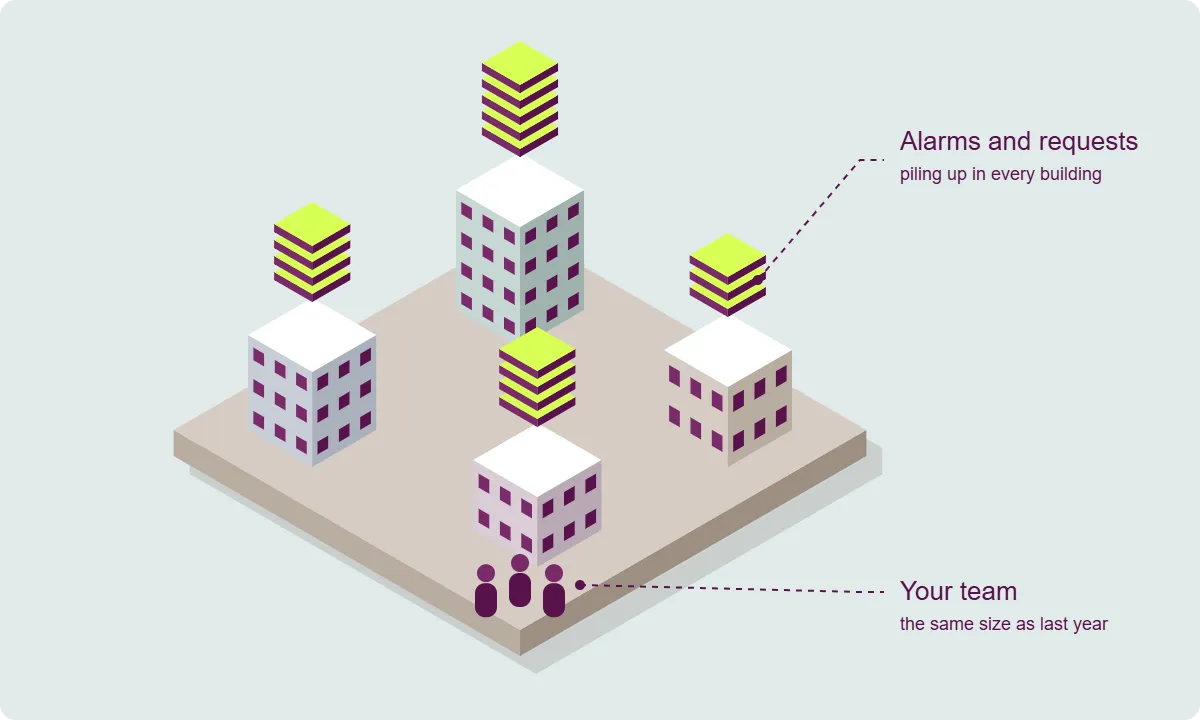
Facility teams have never been leaner or more stretched, and skilled technical staff are only getting harder to find and keep — while the systems meant to help mostly generate more work to do.
Everything is reactive: you only find out something’s wrong when a tenant complains or an alarm floods your inbox. Alarm fatigue is real, because hundreds of nuisance alarms a day mean the one that actually matters gets buried in the noise. Every ticket is manual — someone reads the request, guesses the priority, works out who owns it, and dispatches it by hand. The same routine checks, resets, and adjustments come around every week and eat hours that should go to planning and prevention. And nothing talks to anything: a different BMS in every building, none of them comparable, none of them speaking the same language.
The data to fix all of this already exists in your buildings. It’s just trapped — unreadable across vendors and unusable by anything that could act on it.
From system of record to system of action
Your BMS is a system of record. It logs setpoints, temperatures, alarms, and runtimes — a faithful account of what your building is doing. What it can’t do is decide what to do next and carry it out.
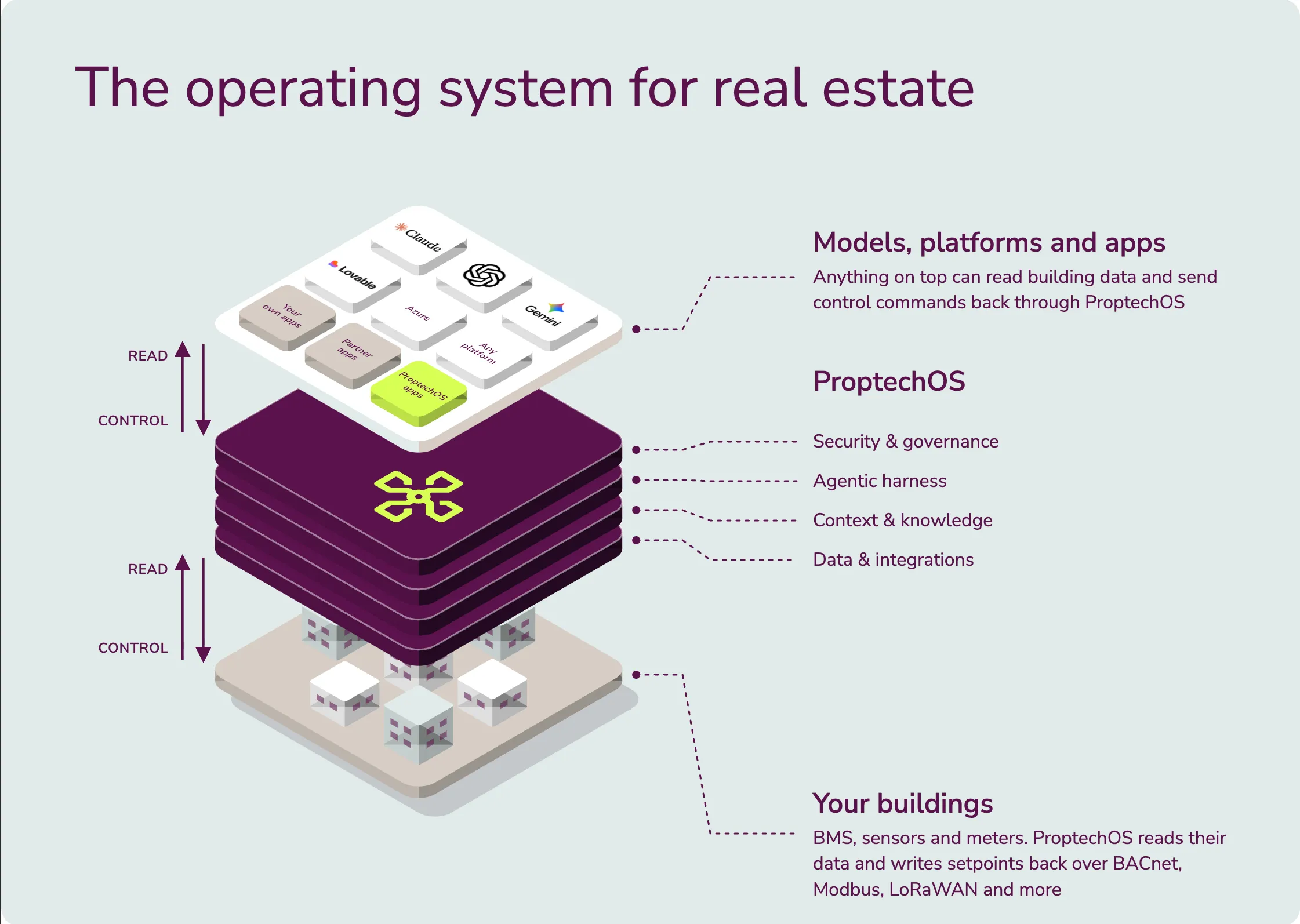
That’s the gap ProptechOS closes. We use the open RealEstateCore standard to normalise data from any BMS or Internet of Things (IoT) source into one common language, then run AI agents on top of it. Agents classify each problem, prioritise it, route it, and where it’s safe to, resolve it, the way an experienced colleague would.
Your BMS tells you what’s wrong. ProptechOS does something about it.
New colleagues for the work that repeats every week
Each agent takes one kind of repetitive, time-consuming task off your team’s list. Your engineers stay in charge and decide what the agents may do on their own.A service request triage agent reads incoming requests, classifies and prioritises them, and routes them to the right team automatically — with the context they need attached. No triage bottleneck, no misrouted tickets, no “who owns this?”
Alarm intelligence filters nuisance and duplicate alarms and surfaces only what genuinely needs a human, so your team sees the alarms that matter, as they happen.Routine task automation runs recurring checks, resets, and adjustments on their own — on a schedule or a trigger — so your engineers get their hours back for the work that actually needs judgement.
Presence-based optimisation. Most BMS setups run heating and ventilation on fixed schedules regardless of who’s actually in the building — full load on weekends, holidays, even during a shutdown. Agents tune operation to real occupancy, so you stop paying to heat and cool empty space.Predictive maintenance. Agents watch live building data for early signs of drifting performance or failing equipment, and flag them before they become a tenant complaint or an emergency callout. In one portfolio, pattern-matching across work orders caught the same sensor being replaced five times in two years.
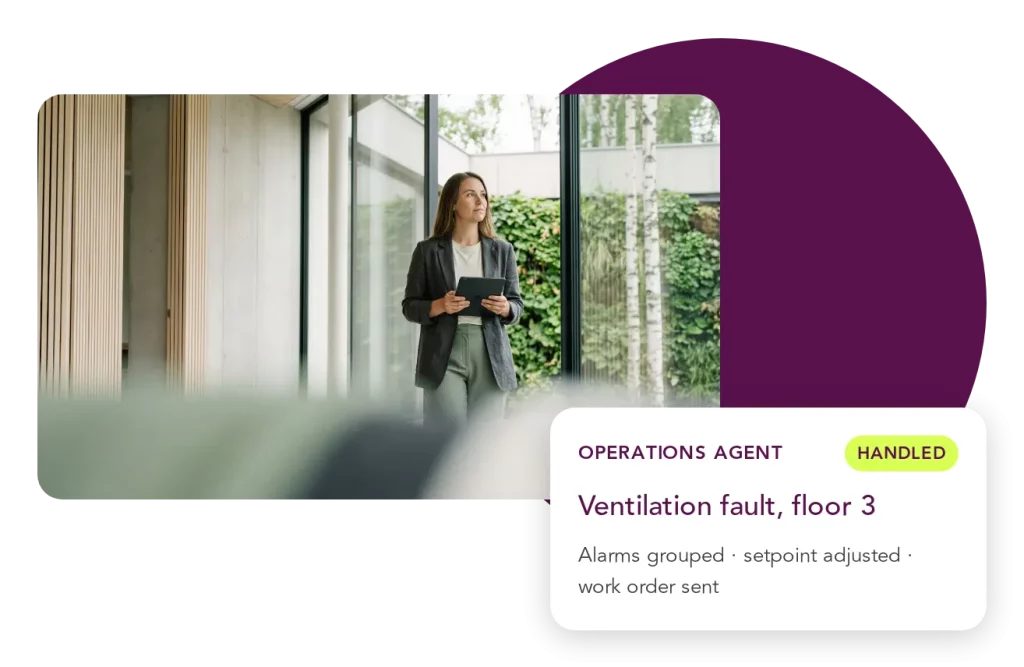
Too-hot and too-cold comfort complaints get investigated against live building data automatically, so the fix is targeted from the start. And it all runs from one view across the estate — every building, every vendor, one normalised layer — so whether you’re the one fixing things or the one reporting on them, everyone works from one dashboard with one login.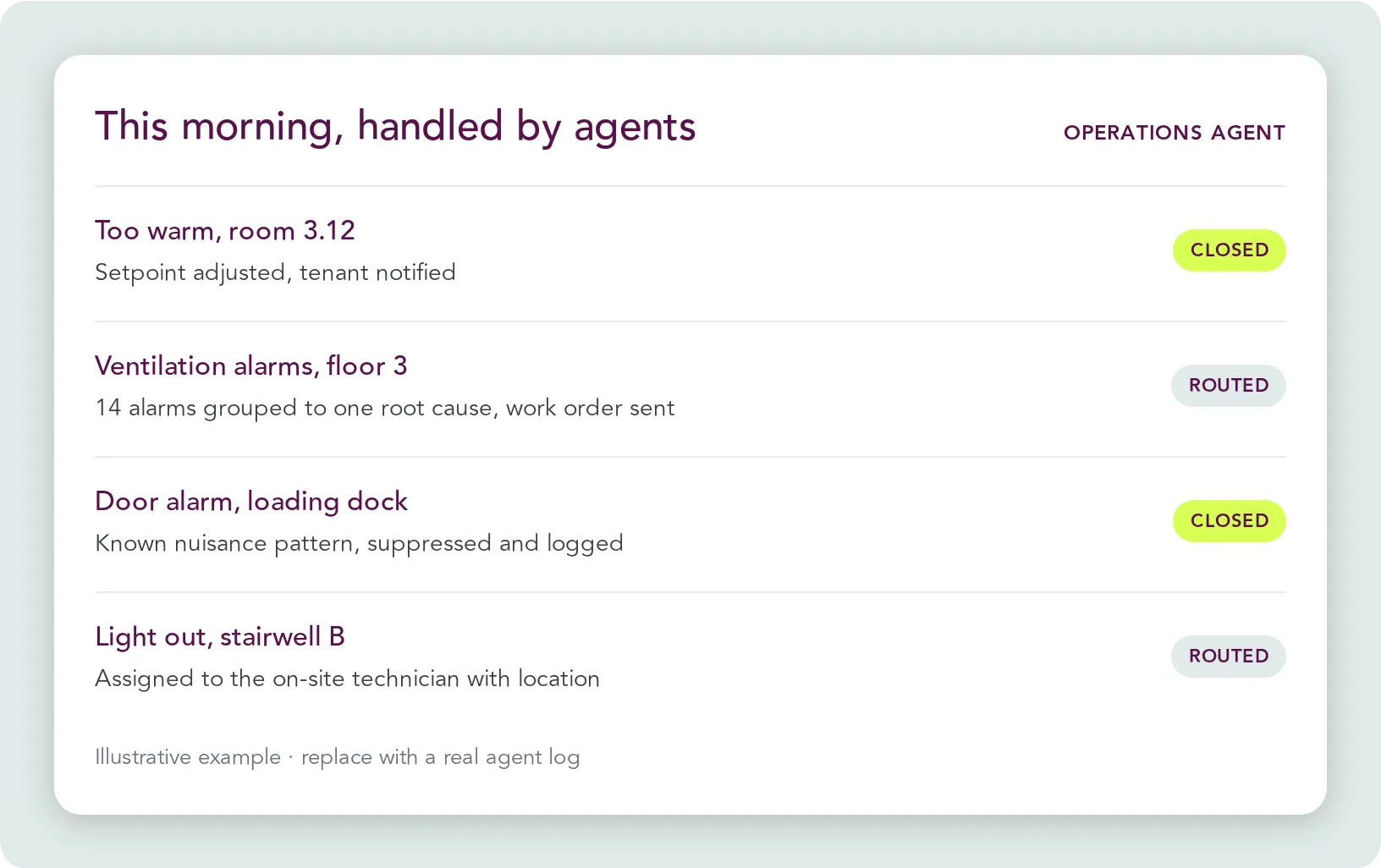
No rip and replace. It works on top of your existing BMS.
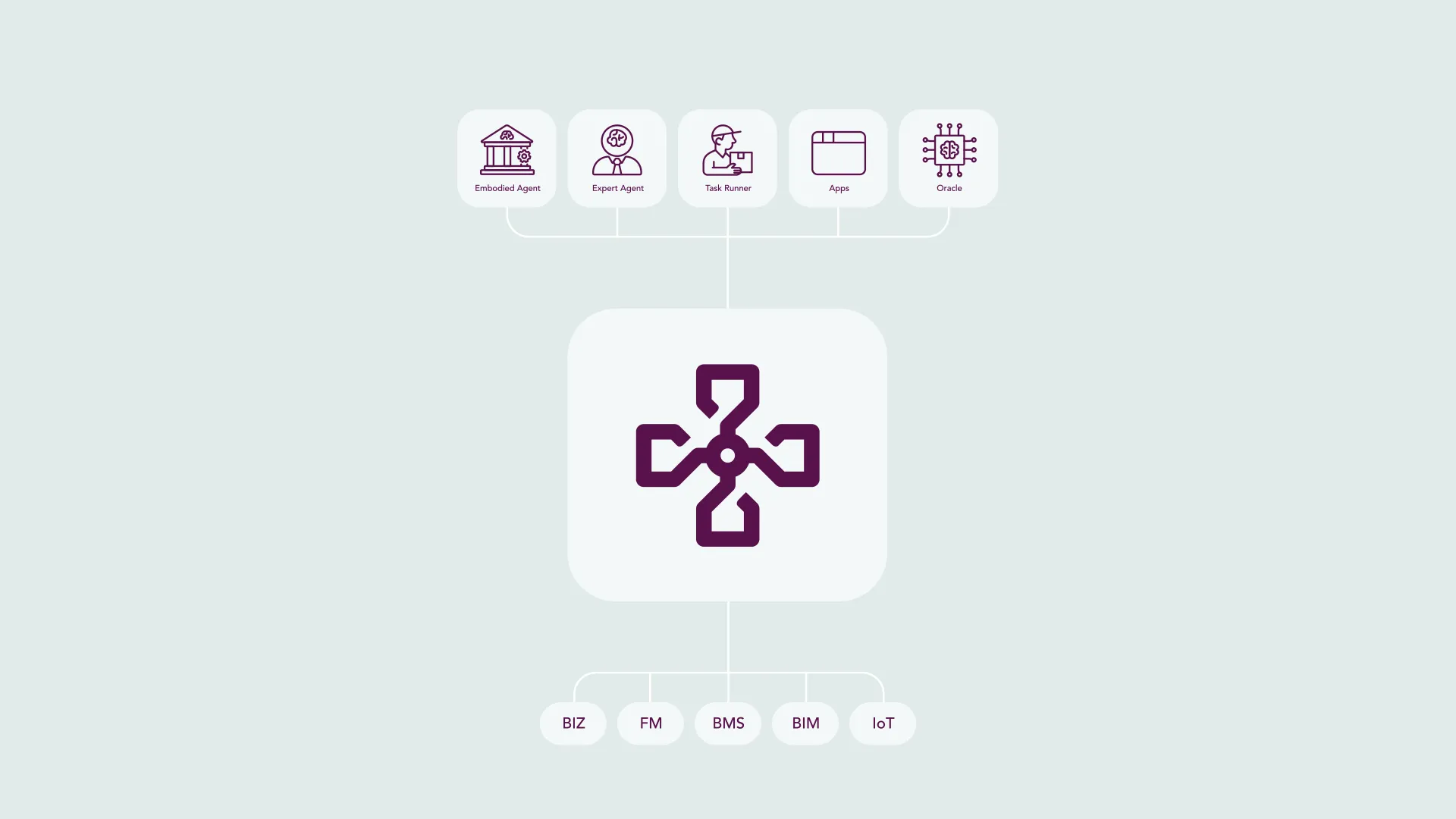
You don’t replace anything. ProptechOS connects to the BMS and IoT systems you already run — across every vendor and every building — and normalises them onto the open RealEstateCore ontology. That common layer is what lets agents reason and act across a mixed estate that could never talk to itself before.
It works in three steps. First, connect: we integrate your existing BMS, meters, and IoT sources, any vendor and any building. Then normalise: everything is mapped to one open standard, so all your buildings finally speak the same language. Then act: AI agents go to work on triage, alarms, routine tasks, and prediction — under the guardrails you set.
Open standard. You own your data. No vendor lock-in.
What changes for your team
Fewer nuisance alarms reach your team, because an agent filters them first. A large share of service requests are triaged and routed before anyone opens the queue. Engineers get hours back every month for planning and prevention, the work that needs their experience.
What this looks like in practice
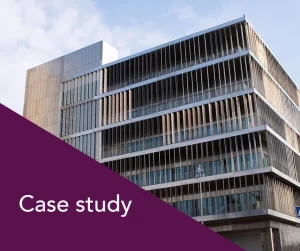
Locum runs Region Stockholm’s hospitals and healthcare facilities, where a missed alarm or a delayed work order affects patient care. Their alarm dashboard had grown too large to triage by hand, and when sensor data stopped flowing, nobody noticed for days.
Six months into their pilot on ProptechOS, sensors now trigger work orders directly in Locum’s FM system, and the full loop from alarm to completed action has been proven end to end. AI agents ran alongside human consultants, analysing deviations and proposing work orders. Their output matched closely enough that Locum is now setting up a permanent team of agents. Four analyst agents will cover heating, cooling, ventilation and electricity against 85 KPIs. A supervisor agent will filter out noise before anything reaches the FM system, and an executor agent will close work orders that don’t need a site visit. Every AI-generated work order is still reviewed by a person before it’s assigned.
Specialist work has sped up too. A regulatory inspection report that used to need a two-day consultant engagement now takes one of Locum’s own specialists four hours.
“One of the most important things in this pilot is being able to resolve faults before the customer has even discovered they exist.” — Thomas Ahlberg, Technical Manager, Locum
Read the Locum case study: https://proptechos.com/case-studies/locum-ai-agents-hospitals/