
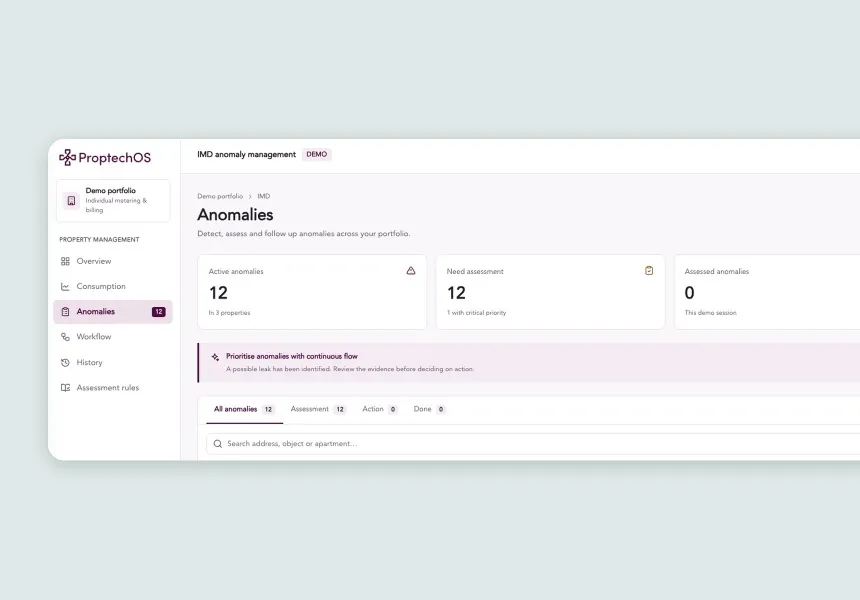
What is the point of finding a fault if nobody knows what happens next? Residential property companies already have reports and filters that flag broken meters, communication failures and unusual consumption in individual metering and billing. The hard part comes after the alarm: working out what it means, deciding what to do and making sure it gets done. That is the work AI agents can now take on.
Finding deviations is rarely the problem
Conversations with housing companies across the Nordics show a consistent pattern. Detecting deviations is largely solved. Metering systems raise alarms, reports list meters with zero consumption, and filters highlight spikes and silent meters. The time goes into everything that follows.
Teams sort the alarms, try to find the root cause and decide who should act. Morning and afternoon planning meetings are spent going through lists. Actions are handed over, reminders are sent, and some cases still fall between the cracks. Sometimes the root cause is found. Sometimes it is not.
The core question is the same every time: was it a metering error, an empty apartment or a real problem in the building? And once someone acted, was the action completed? When a case is passed on, the overview disappears and responsibility becomes unclear. More alarms and better reports do not change that if nobody owns the case from start to finish.
A missing reading and a zero reading mean different things
Getting the answer right starts with a distinction that is easy to blur. A meter that sends no value has a communication problem: a battery has run down, a gateway is offline or a collector is out of range. A meter that reports zero is working, and it is telling you that nothing was used. Treating the two as the same leads to wrong conclusions in both directions, which is why AI agents keep them strictly apart from the first step.
From alarm to recommended action
ProptechOS currently runs around 50 AI agents that work continuously for customers. Several of them take on the work that follows a metering alarm.
The first looks across alarms and checks whether they are connected. Ten alarms can share a single root cause, and establishing that manually can take hours or days. When the agent groups them, the team handles one case where it would otherwise have handled ten.
The IMD deviation agent then assesses each case. It identifies meter deviations and broken meters, and sorts them into technical faults, expected deviations with a known explanation (a replaced meter, a vacant apartment, consistently low but stable consumption), cases that need a site visit and cases where supporting data is missing. For each one it writes a recommendation: a drafted fault report ready to send, or a note that no action is needed. The property owner sets the thresholds, and every recommendation comes with the reasoning behind it.
Alongside this, ProptechOS has tools that check every month that heating, ventilation and controls across the whole portfolio work as intended, and show where to start. Metering deviations can then be read against how the building itself is performing.
The quietest case is often the most important one
Spikes and dead meters are easy to notice. The harder case is an apartment registered as let that shows no hot water use for weeks or months. The cause could be a faulty meter, a meter mapped to the wrong apartment, a vacancy that was never registered or an apartment that is not lived in as the contract assumes. Each affects billing, maintenance and sometimes tenancy management. Agents find these cases by continuously comparing meter data with tenancy status from the property system, something that is slow and error-prone to do by hand across thousands of apartments.
From 24 days to two hours
On average, around 24 days pass from the moment a meter drops out until an action is started. With agents doing the first round, that happens within two hours. [insert: confirm source and basis for the 24-day figure]
The report can arrive in the inbox in the morning, at lunch and in the afternoon, timed to how the team plans its day. Agents also follow up on actions that have not been taken, and check whether a completed action fixed the problem. That closes the loop that usually breaks when a case is handed over.
Clean meter-to-apartment data is the prerequisite
Each meter needs to be mapped to the right apartment, and tenancy status needs to be available from the property system. ProptechOS connects metering systems, property systems and building data through ready-made connectors and a shared data layer built on a digital twin of the portfolio. Where the mapping is incomplete, the agents do not guess. They mark the case as missing data, which turns gaps in the data foundation into a visible list the organisation can work through.
The organisation has to own the process
Agents can take the first round, but ways of working have to develop as they take on more of the daily work. Who receives the report? Who assesses the recommendations and decides on action? Who is responsible for making sure the case is closed?
These questions belong to the organisation. In agentic operations, agents work as a new kind of colleague that takes on recurring tasks, and the value depends on the people and processes around them. Property owners that define ownership for each step get faster action, fewer cases lost between teams and a documented history of which buildings, meters and apartments tend to cause trouble. [insert: customer case — reduction in manual review time or billing corrections]
See how ProptechOS helps you monitor and manage individual metering and billing with our interactive IMD demo.
