
Most property work done at a computer could already be done by AI, but it still isn’t. Eighteen months ago that was true for ProptechOS too. People carried work between systems, context lived in people’s heads, and answers stayed with whoever gave them. Today agents on ProptechOS have completed more than 12 000 tasks so far this year, and the time between a conversation and its consequence is often measured in minutes. We did this to ourselves first. This is how, what it changed, and why agentic operations for real estate are now what we offer.
- What is agentic speed? Agentic speed is the time between a conversation and its consequence: how quickly a meeting, a decision or an alarm turns into completed work.
- What are agentic operations for real estate? Agentic operations is operational work in real estate done by AI agents. The agents read live building and business data, act within the rights they are granted and hand results to people or other agents. Real estate professionals stay in charge.
The moment the work changed
We built ProptechOS to solve one problem: property owners had no real access to their own building data, and every new integration was slow and expensive. Our answer was an operating system for buildings. It reads from and writes to operational systems, with granular rights for everything that runs on it, and it is built on RealEstateCore, the open standard for building data.
In spring 2025 we connected large language models to ProptechOS through MCP. Watching an AI model use our platform directly, we saw that much of the work done in and around buildings no longer needed a dedicated application. A domain expert with an AI assistant, or an autonomous agent, could do it on demand.
That raised a direct question for us as a company. If agents can do this work for our customers, they can do it for us. So we started with ourselves.
Work only moved when we moved it
For me, the hardest part was admitting how much of our own work only moved because someone remembered to move it. When we looked honestly at our own operations, what limited our speed was everything around the work: handovers, context and knowledge.
- Handovers were manual. Someone carried each piece of work from one stage to the next, often copying information between systems that were not linked.
- Context stayed offline. Why a meeting happened, or who a new feature was really for, lived in people’s heads.
- Knowledge did not compound. Every answer to a support question stayed with the person who gave it.
Anyone who runs buildings will recognise the pattern. Facility teams carry work between the BMS, the FM system, work orders and meters in exactly the same way.
Four steps to make our work readable for agents
- Inventory the work.
We mapped which tasks each team does, how much time each takes and how much it matters. In onboarding, 80% of the time went to four tasks. We automated those first.
- Connect the systems of record.
Agents got controlled access to project management, our source code repositories and the CRM.
- Capture the conversations.
Nine out of ten of our meetings are digital. Together with Slack and email, they flow into our own knowledge system, with wide but controlled access.
- Keep every answer.
A knowledge base grows with every answer and decision. People and agents use it alike, and one agent keeps it current from our conversations.
The result is that handovers became deterministic. When the state of a piece of work changes, the next step starts.
Task, agent, harness, systems of record
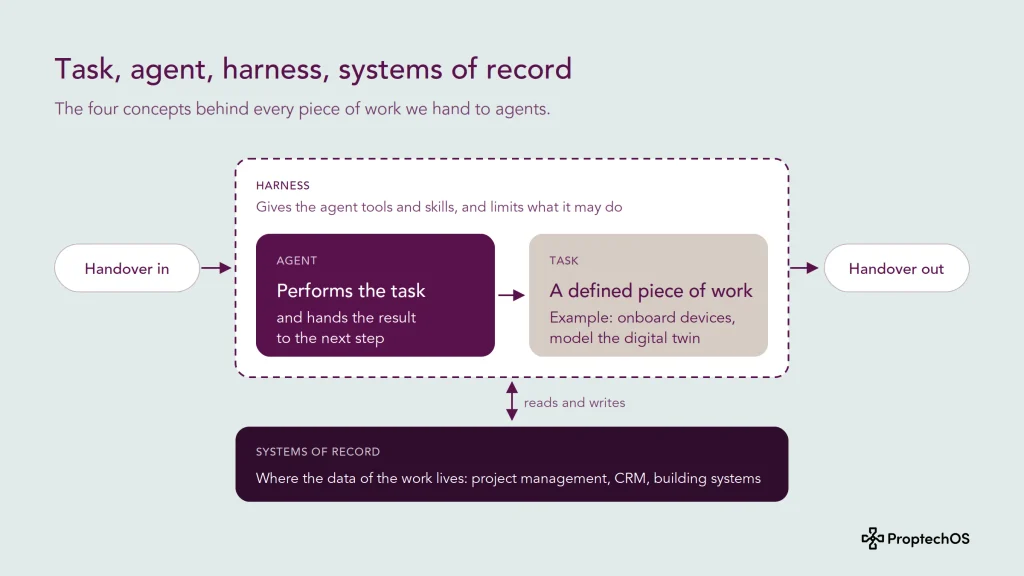
Every piece of work we agentify is described with the same four concepts.
- Task: a defined piece of work with a handover in and a handover out. Onboarding devices is one example: modelling the digital twin and connecting the integration.
- Agent: performs the task and hands the result to the next step.
- Harness: gives the agent the tools and skills to use outside systems and data, and limits what it may do.
- Systems of record: where the data of the work lives. The agent reads and writes there only through the harness.
From there the method is repeatable, task by task. Identify and prioritise the task, trace it to its systems of record, choose or build the harness, then iterate on the task and its handover until it runs reliably. The same model applies directly to building operations, where ProptechOS is the harness and the building’s operational systems are the systems of record.
Agentic speed: from conversation to consequence
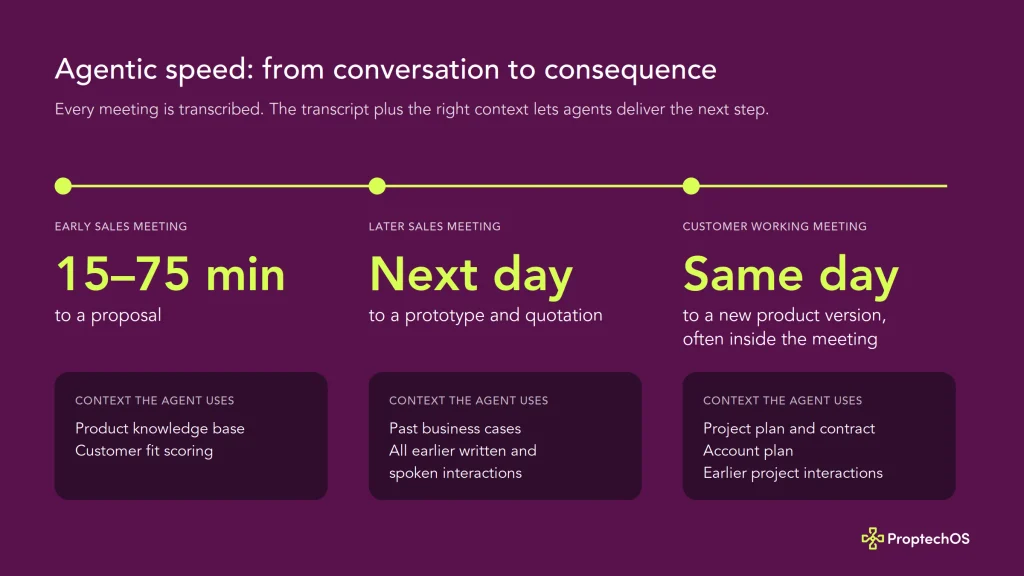
Every meeting we hold is transcribed. The transcript plus the right context lets agents deliver the next step: a proposal within 15 to 75 minutes of an early sales meeting, a customer-specific prototype and quotation the next day, and often a new product version before a customer working meeting has ended.
The effect on sales alone: in the twelve months after we changed how we work, we sent more than four times as many proposals as in the twelve months before, with a smaller team.
What changed
The clearest evidence is in the work our customers see: buildings onboarded, systems connected and tasks completed.
| Measure | Before | Now |
|---|---|---|
| Buildings onboarded | 2 000 in six years, 2019–2025 | More than 6 000 in one quarter, Q3 2026 |
| Connectors to operational systems | 60 built in seven years | 71 more in nine months of 2026 |
| Time to build a new connector | About one week | Under one hour, start to production |
| Our first 3D digital twin | Estimated at 40 hours | In production after 40 minutes |
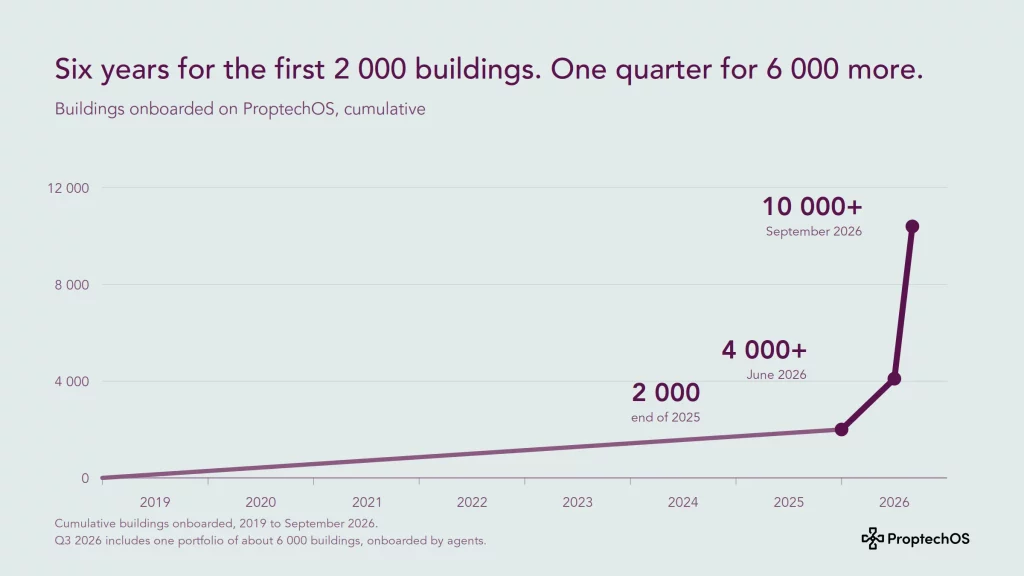
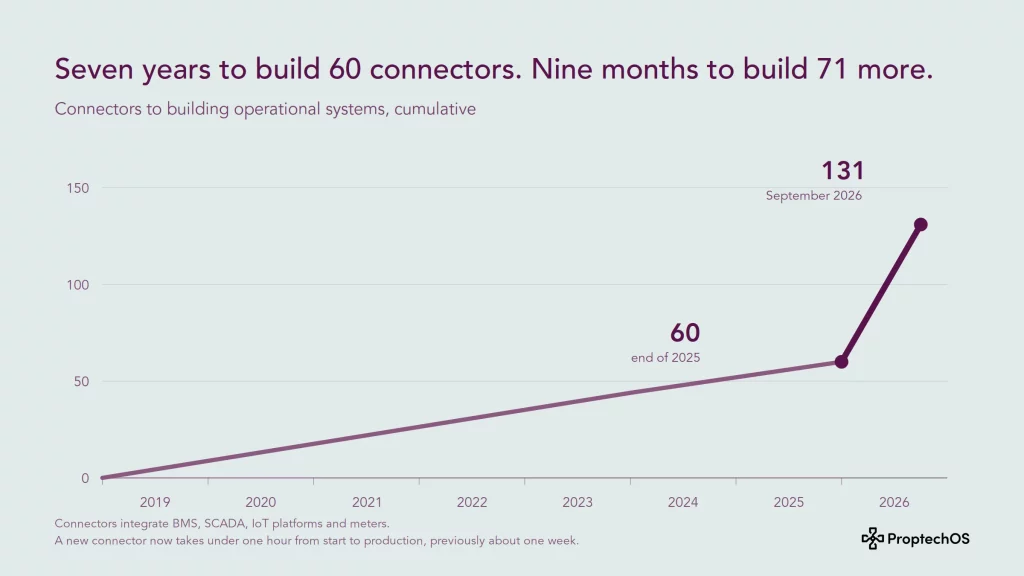
The Q3 figure includes one new customer’s full portfolio of about 6 000 buildings, onboarded by agents. Connectors can now be provisioned, and even built, by people who are not developers. Each one is also reusable for the next customer with the same system.
Agents at work in real buildings
The same platform now runs agents in our customers’ live operations. Across the platform, agents have completed more than 12 000 tasks so far in 2026, from hourly plant checks to daily analyses and enrichment of building data. More than 300 agents are in production. At a conservative 15 minutes of expert work per task, that is more than 3 000 hours of expert work, time that operations teams can spend on decisions.
Two examples from the Nordics:
- Vasakronan built SpotOn Control, an AI agent, with ProptechOS. It has been nominated for Tech Excellence Innovation at Dagens Industri’s Tech Excellence Awards.
- KLP reduced energy use by 31% at its Eufemia property with ProptechOS.
Agents can work across building systems and business systems alike: BMS, meters and IoT on one side, FM, work orders, leases, tenant data and BIM on the other. That lets them do cross-system property work, such as turning a deviation in a plant into a correctly routed work order. ProptechOS is also open to any AI model. Customers’ own AI tools and partner agents can operate on the same harmonised data through MCP, within the same rights.
Speed with guardrails
Our agents act on real buildings, so speed only counts when it is governed. The rights model we originally built for applications now governs every agent.
- Permission policy per agent: each agent gets only the access and rights it is granted, down to the individual data point.
- Audit trail: every action an agent takes is recorded and traceable.
- Observability: we and our customers see what agents do, as they do it.
- Security and compliance: ISO 27001 and NIS2, for operations that count as critical infrastructure.
Business-critical means someone has assured it. An agent that ran once is a demo.
Agentic Fridays
Tools did not change our habits by themselves. Building away your own manual work while doing that work takes deliberate time.
Every third Friday, everyone at ProptechOS agentifies part of their own team’s processes. It gives us coordinated time for the change, so it does not get squeezed in between everything else. It has become our most loved institution and our fastest learning loop. Alongside it, more frequent all-hands strategy reviews keep everyone aligned on where we are heading and why.
Where to start in your portfolio
The four steps that worked for us work for building operations too.
- Inventory the operational work. List the recurring tasks: alarm handling, meter readings and anomalies, work order triage, energy follow-up, tenant requests. A few tasks usually take most of the time. Start there.
- Connect the systems of record once. BMS, SCADA, meters and IoT, plus FM, work order, lease and tenant systems. Connectors read data and write control back.
- Give agents context. Harmonise the data on an open standard such as RealEstateCore, so any agent understands what a sensor, a room or a lease is, and how they relate.
- Start with one task and its handover. Grant the agent only the rights it needs, keep the audit trail on, and expand once it runs reliably.
Most of our customers start with a shared view of their data in dashboards, then add agents for tasks that are repetitive or not done at all today. Your team stays the expert and in control. Agents add speed and scale.
What this means for real estate
We believe the operational work of real estate will be done by AI agents, led by real estate professionals. Our role is to make building and business data usable for any AI model, so that agents can run real estate operations. That is what we mean by agentic operations for real estate professionals.
Real estate companies use AI in three ways. Autonomous expert agents take on the repeatable operational work around the clock. Domain experts build the tools they need on their own data. Experts with AI assistants get answers and analysis on demand. All three need the same foundation from the building: live data, harmonised so agents understand it, the ability to write back to operational systems, and rights that control what each agent may do. That foundation is ProptechOS.
The potential is large. Morgan Stanley Research estimates that 37% of tasks in real estate can be automated. Our own study from early 2026 puts the figure for building operations at 48%. Our target is best-practice operations in energy, tenant experience and operational quality at about half the work.
We have moved from systems people use to agents that work for people, with agents in production and our own numbers to show for it. I believe every real estate team can make the same move, one task at a time. See how agentic operations work, or book a demo to explore what agents could take on in your portfolio.
Frequently asked questions
What are agentic operations for real estate? Operational work in real estate done by AI agents that read live building and business data and act within the rights they are granted. Real estate professionals lead the work and stay in control.
Where should a property owner start with AI agents? Inventory the recurring operational tasks, connect the systems that hold their data, and start with one task and its handover. Most owners begin with a shared view of their data, then add agents for repetitive work.
How are AI agents governed in ProptechOS? Each agent has its own permission policy down to the individual data point, every action is recorded in an audit trail, and operations are observable as they happen. Built to the requirements of ISO 27001 and NIS2, for operations that count as critical infrastructure.
Do agents replace facility teams? Agents take on repeatable monitoring, analysis and routine actions. The team stays the expert, decides what agents may do and spends more time on decisions.
Which AI models can work with ProptechOS? Any. ProptechOS harmonises building and business data on the open RealEstateCore standard, and AI models and agents connect through MCP, within the rights they are granted.
