

The word is everywhere in proptech right now, and most of it means “AI, but newer.” Here is the actual distinction that matters — and why it changes how a building runs, not just how it reports.
The short answer
In building operations, agentic describes AI that acts, not just analyzes. An agentic system senses live conditions across a building’s systems, reasons about operational goals, and takes action on its own — inside guardrails set by the operator. It’s the shift from software that tells you what to do to software that does it and reports back.
Automation, analytics, agentic — three different things
These terms get used interchangeably, but they describe three distinct levels of what software actually does inside a building. The difference is not how smart the system sounds. It’s who closes the loop.
1. Automation — rules you set
A building automation system runs schedules and setpoints exactly as programmed. It’s deterministic and reliable, but blind to anything outside its rules, and it only changes when a person reprograms it.
2. Analytics — insight it surfaces
Fault detection, forecasts, and dashboards. This layer tells you what’s wrong, what’s coming, and often what to do about it. The judgment improves, but a human still has to take every action.
3. Agentic — action it takes
The system senses conditions, decides on a course, and acts on the building itself, then learns from the result. It closes the loop that automation and analytics leave open, within defined guardrails.
What makes a system agentic
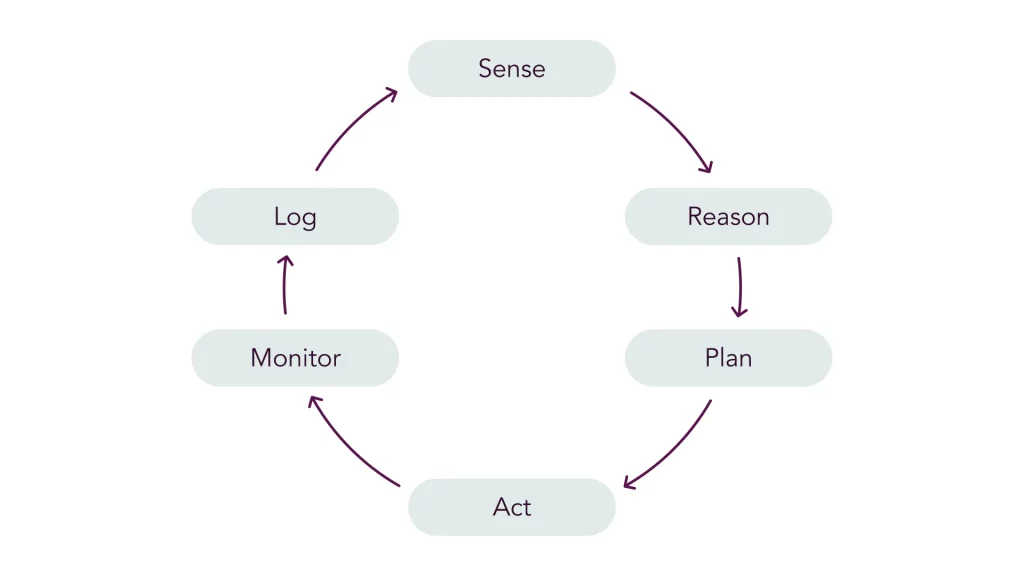
Six stages have to work together. Drop any one and you’re back to a dashboard or a schedule.
Sense — ingests live signals across the estate (BMS points, IoT sensors, meters, occupancy, weather, and energy tariffs) as a single, current picture of building state.
Reason — interprets that picture and weighs competing goals: occupant comfort, energy cost, carbon, and equipment health rarely point the same way, so the system has to settle which of them wins.
Plan — turns that into a concrete course of action — which setpoints to move, which schedules to shift, which work order to raise — sequenced and checked against operating limits before anything changes.
Act — writes back to building systems, executing the plan rather than stopping at a recommendation for someone else to carry out.
Monitor — tracks what actually happens against what was intended, catching drift or unintended effects while there’s still time to correct.
Log — records every decision and its outcome, creating the audit trail that keeps actions accountable and gives the next cycle something to learn from.
So operating a building becomes a continuous loop, not a periodic re-tune.
System of record, system of action
Agentic AI doesn’t replace the building automation system — it sits on top of it. The clearest way to hold the two apart is by the job each one does.
The BMS / BAS is the system of record: the source of truth for what the building is and what it’s doing right now — points, equipment, schedules, and the control substrate that carries out commands.
Agentic AI is the system of action: the intelligence layer that reads that truth, decides what should change to meet operational goals, and acts on it — continuously, across every building at once.
Why the distinction matters: a building already has a system of record. What most estates have never had is a system of action that can operate the building continuously without a person in the loop for every decision. That gap is what “agentic” fills.
What it looks like on the ground
Abstract until you see one run end to end. Here is a single agentic action, broken into the five things that define it.
Scenario: pre-empting a comfort complaint before it’s filed — multi-tenant office.
Trigger — occupancy sensors and calendar data show a top-floor zone filling two hours earlier than its scheduled ramp, with an outdoor-temperature spike forecast for the same window.
Action — the agent brings that zone’s cooling forward and re-sequences the affected air handling unit, staging the change to avoid a demand-charge spike across the plant.
Systems and data — BMS zone points, AHU control, occupancy and calendar feeds, weather forecast, and the interval meter, resolved against the RealEstateCore model of the building.
Guardrail — setpoint moves stay inside operator-defined comfort and equipment limits; anything beyond the bounded range is proposed for approval rather than executed.
Measure — tracked against comfort-complaint rate, time-to-comfort, and peak demand for the zone, so the outcome is verifiable, not assumed.
Agentic doesn’t mean unsupervised
The common objection is that autonomous action in a live building sounds risky. The word that resolves it is guardrails. An agentic system operates with bounded authority: it acts freely inside limits the operator sets, escalates anything outside them, and keeps a human in the loop for high-stakes decisions. Autonomy is scoped on purpose — the point is to remove the routine decisions from a person’s plate, not the judgment.
The right question isn’t “can it act?” — it’s “what is it allowed to act on, what happens at the edge of that, and can I see every decision it made?” A credible agentic system answers all three.
Common questions
Is agentic AI the same as a smart building?
No. “Smart building” usually describes connected systems and data — the building can be observed and controlled remotely. Agentic AI is about what acts on that data. A smart building gives you the visibility; an agentic layer decides and acts on it.
Doesn’t a modern BAS already do this?
A BAS executes rules a person configured, and optimization modules can tune within those rules. What it doesn’t do is reason across competing goals and take open-ended action toward an outcome. It runs the logic it was given; an agent decides what the logic should be, then acts.
Does agentic mean removing the operator?
No — it changes what the operator spends time on. Routine, high-frequency decisions get handled automatically within guardrails, so the operator moves from reacting to individual issues to setting intent and reviewing exceptions across the whole portfolio.
What does an agent need to work across a whole estate?
A consistent model of what each building contains, so data from different vendors and systems means the same thing everywhere. That shared semantic model — an ontology such as RealEstateCore — is what lets one agent reason and act across buildings that were never built to talk to each other.
In one line
Agentic building operations means the software stops handing you a to-do list and starts closing the loop itself — perceiving, deciding, and acting on the building, within guardrails you control.
Want the complete framework? Read our guide to agentic building operations, including architecture, use cases, guardrails, and how to prepare your buildings.
