

What is a Building Automation System (BAS)?
A Building Automation System (BAS) is an intelligent network of integrated hardware and software that transforms traditional buildings into responsive environments. At its core, BAS technology unifies and controls critical building functions – including HVAC, lighting, security, and energy management – through a centralized platform that actively monitors, analyzes, and optimizes building operations in real time.
According to research by the American Council for an Energy-Efficient Economy, modern BAS can reduce HVAC energy costs by up to 50% while maintaining optimal comfort levels.
Unlike basic control systems, modern BAS leverages artificial intelligence and IoT sensors to create self-adjusting, predictive environments that enhance occupant comfort and operational efficiency.
Where building automation ends and agentic operations begin
A BAS executes. It runs control loops, holds setpoints, and responds to conditions someone configured it to recognize. What it does not do is decide what should change, or why. Agentic building operations add that layer: software agents that read across the BAS, the building’s data model, bookings, weather and price signals, form a judgment about what the building should do next, and act on it inside limits the operations team sets.
Your BAS remains the system of control. Your data model is the system of record. The agent layer is the system of action.
How Building Automation Systems Work: The Digital Nervous System
Think of a BAS as your building’s digital nervous system, constantly sensing and responding to changes through three key components:
The Sensing Layer
Advanced IoT sensors act as the building’s sensory organs, continuously monitoring:
- Temperature fluctuations across different zones
- Occupancy patterns and movement flows
- Indoor air quality metrics (CO2, humidity, particulates)
- Natural light levels and artificial lighting conditions
- Energy consumption patterns in real-time
The Processing Layer (Building Intelligence)
While traditional BAS controllers handle basic operations, modern solutions like ProptechOS act as an intelligent operating system layer that: Modern BAS controllers leverage machine learning algorithms to:
- Process thousands of data points per second
- Identify patterns in building usage
- Predict maintenance needs before failures occur
- Optimize energy usage based on historical patterns
- Learn from occupant preferences and behaviors
The Action Layer
Smart actuators and controllers execute precise adjustments:
- Dynamic HVAC modulation based on occupancy
- Automated lighting that adapts to natural light availability
- Predictive elevator dispatching during peak hours
- Security system responses to unusual activity
Beyond the three layers: the decision layer
Sensing, processing, and action form a closed loop — but only over what someone configured in advance. Everything outside that configuration becomes an alarm, a ticket, or a slow manual investigation. That gap between what the BAS can execute and what actually needs deciding is where most operational cost sits.
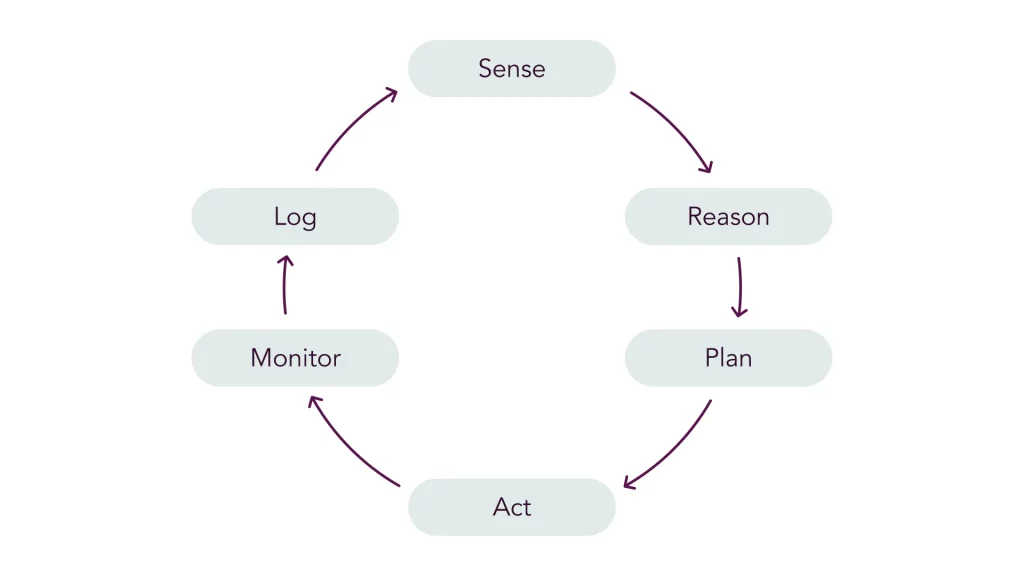
An agent closes the loop in four steps:
- Observe — read the deviation across systems, not just the single point that alarmed
- Diagnose — separate a failing valve from a wrong schedule from a drifting sensor
- Act within bounds — adjust inside operator-defined limits, or escalate with the evidence attached
- Verify — confirm the change held, and reopen if it didn’t
The fourth step is what separates agents from analytics. Fault detection tells you something is wrong. An agent tells you whether the fix worked.
BAS vs. BMS: Is there a difference?
Navigating the world of building automation can sometimes feel like trying to understand the difference between ‘tomayto’ and ‘tomahto’. Within the industry, you’ll often hear Building Automation Systems (BAS) and Building Management Systems (BMS) tossed around like they’re two sides of the same coin. And here’s the inside scoop: they pretty much are. While some folks might dive into the nitty-gritty, arguing the technicalities, the reality is that these two terms are used more or less interchangeably in the day-to-day operation of buildings.
Even big players in the BAS space use these labels interchangeably. Schneider Electric says, “A BMS is also called a building automation system (BAS).” Ericsson tries to cut through these labels by calling their building management system an “Indoor Manager.” Even Science Direct uses these terms interchangeably on its site.
What Makes Modern BAS Different: Beyond Basic Automation
Today’s Building Automation Systems have evolved far beyond simple programmable controls. Here’s what sets modern BAS apart:
AI-Powered Predictive Operations
Unlike traditional systems that simply react to preset conditions, modern BAS can:
- Predict maintenance needs weeks in advance
- Adjust operations based on weather forecasts
- Learn from occupant patterns to optimize comfort
- Identify energy-saving opportunities automatically
Digital Twin Integration
Leading BAS platforms now incorporate digital twin technology to:
- Create virtual replicas of building systems
- Simulate changes before implementation
- Test optimization strategies risk-free
- Provide immersive 3D visualization of building operations
Smart Grid Integration
Modern BAS can interact with power grids to:
- Participate in demand response programs
- Optimize energy usage during peak pricing
- Integrate with renewable energy sources
- Support microgrid operations during outages
The building operations autonomy ladder
Most discussion of “smart” buildings collapses six very different operating modes into one word. A ladder makes the gap visible:
| Level | Mode | What it looks like |
| 0 | Manual | Technicians adjust in response to complaints |
| 1 | Scheduled control | Fixed time schedules and setpoints in the BAS |
| 2 | Reactive optimization | Demand-controlled ventilation, daylight dimming |
| 3 | Advisory analytics | Faults and recommendations surfaced; a human decides and executes |
| 4 | Bounded autonomy | Agents act inside defined limits and escalate outside them |
| 5 | Supervised portfolio autonomy | Agents coordinate across buildings and external signals; humans set policy, not individual actions |
Most portfolios run at level 1–2 with pockets of 3. The step that changes operating cost is 3 → 4, because it removes the human from the execution path without removing them from the control path.
Building automation vs. agentic building operations
| Building automation system | Agentic layer | |
| Job | Execute control logic | Decide what the control logic should be doing |
| Context | Points and schedules within one building | Data model, BAS, bookings, weather, prices, work orders — across the portfolio |
| Response to the unexpected | Alarm | Diagnosis plus bounded action |
| Scale | Per building, per vendor | Vendor-neutral via RealEstateCore |
| Human role | Configure and respond | Set policy and limits, review outcomes |
| Output | Setpoint changes | Setpoint changes plus an auditable reason |
This is your most citable asset on the page — the ladder is the kind of structure answer engines lift wholesale, and nobody in BAS content owns it yet.
Real-World Impact: Beyond Theory
Industry research by Transforma Insights reveals that building automation systems can reduce overall energy consumption by up to 20%. With the smart building industry projected to achieve a 15.8% annual growth rate over the next decade, adopting intelligent building systems is becoming increasingly crucial for staying competitive.
Case Study: The Edge Building, Amsterdam
The Edge demonstrates next-generation BAS capabilities:
- 28,000 sensors monitoring occupant movement
- AI-driven workspace optimization
- 70% reduction in energy usage
- Predictive cleaning based on actual usage
- Automated workspace adjustment to individual preferences
ProptechOS: from building automation to agentic operations
Your building automation system controls equipment. ProptechOS makes those controls act on live data. It connects your BAS and sensors in one open data model and runs AI agents that optimize energy, comfort and maintenance continuously. Your existing systems stay in place, and your team sets the limits.
How ProptechOS Transforms Building Automation
- Unified Control Layer
- Acts as an intelligent overlay for existing BAS
- Connects disparate building systems into a cohesive ecosystem
- Provides a single interface for all building operations
- Enables seamless integration of new technologies
- Advanced Analytics and AI
- Processes building data through sophisticated AI models
- Identifies optimization opportunities across all systems
- Provides actionable insights for energy savings
- Enables predictive maintenance through pattern recognition
- App Ecosystem Integration
- Offers a marketplace of pre-integrated smart building applications
- Allows for easy addition of new functionality
- Enables custom app development for specific needs
- Creates a scalable platform for future innovations
- Energy Optimization
- Real-time energy consumption monitoring
- AI-driven optimization strategies
- Automated demand response
- Carbon footprint tracking and reduction
Real-World Example: Smart Building in Action
Imagine walking into your office building on a Monday morning. The system detects your arrival through your security badge, and ProptechOS springs into action. The elevator is already waiting in the lobby, predicting your arrival based on historical patterns. As you reach your floor, the lights gradually brighten, and the HVAC system has already pre-conditioned your workspace to your preferred temperature. Throughout the day, the system continuously adjusts based on occupancy, external weather conditions, and real-time energy prices while maintaining optimal comfort levels.
Real-World ProptechOS Implementation
When integrated with existing BAS, ProptechOS has demonstrated:
- 15-30% additional energy savings beyond traditional BAS
- 40% reduction in maintenance costs
- 25% improvement in occupant satisfaction
- 50% faster issue resolution times
For instance, using ProptechOS partners, you can set up an automated system to leverage your data insights. Start with Schneider Electric’s EcoStruxure™ to control all of your building systems. Then, you can use Siemens’ Navigator to assess your current operations’ energy efficiency and find ways to improve. Finally, you can connect both of these tools to ProptechOS’ Workflows to automate actions with EcoStruxure based on the insights derived from Navigator.
What agents do on top of an existing BAS
Four patterns, each starting from something a BAS cannot resolve on its own:
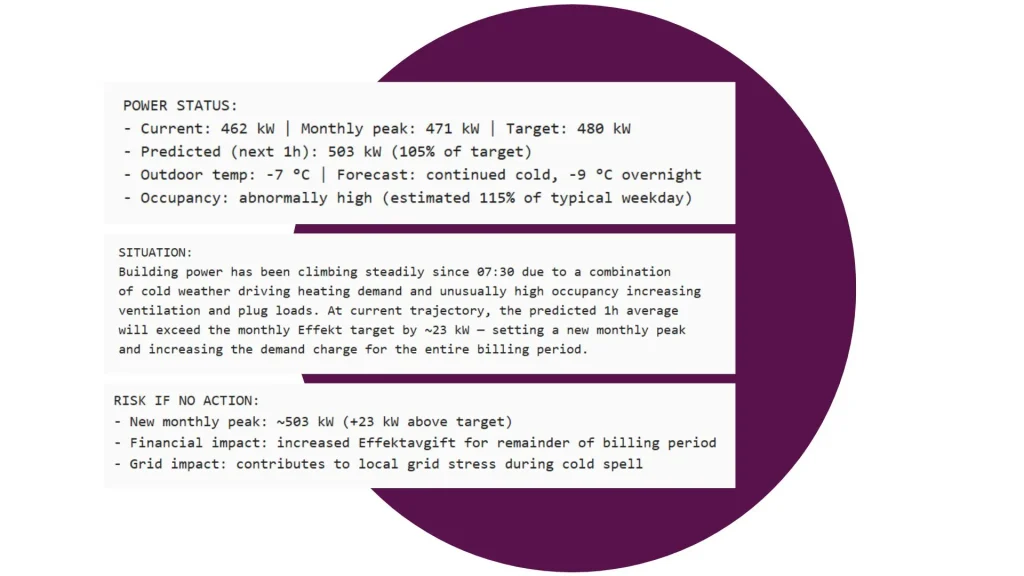
- Indoor climate deviation control — a zone drifts from target. The BAS alarms. An agent traces it to a schedule conflict, a sensor drift, or a mechanical fault, corrects what’s correctable, and raises what isn’t.
- Schedule reconciliation — booking data and BAS schedules disagree. The agent finds the mismatch across the portfolio and aligns conditioning to actual use.
- Fault triage — an alarm becomes a diagnosed, prioritized work order with the supporting data attached, rather than a line in a log.
- Verification — after any change, the agent checks whether the intended effect materialized and reopens the case if it didn’t.
The Future of Building Automation
Emerging Trends and Innovations
- Biometric Integration
- Facial recognition for personalized environment adjustment
- Health monitoring through environmental sensors
- Stress-responsive lighting and temperature control
- Urban Ecosystem Integration
- Building-to-building communication
- Smart city grid integration
- Shared resource optimization
- Community-wide energy management
- Sustainability Focus
- Carbon footprint tracking and optimization
- Renewable energy integration
- Waste reduction through predictive maintenance
- Water usage optimization
Getting Started with BAS and ProptechOS Implementation
Strategic Approach with ProptechOS
- Assessment Phase
- Evaluate current infrastructure capabilities
- Identify primary pain points and objectives
- Analyze potential ROI across different systems
- Implementation Strategy
- Choose open-protocol systems for future flexibility
- Start with high-impact areas first
- Ensure scalability for future expansion
- Continuous Optimization
- Regular performance analysis
- System learning and adaptation
- Stakeholder feedback integration
Measuring Success: Key Performance Indicators
Track these metrics to ensure BAS effectiveness:
- Energy usage reduction (target: 30-50%)
- Maintenance cost reduction (target: 20-40%)
- Occupant satisfaction scores
- System response time
- Predictive maintenance accuracy
Taking Action
In an era where buildings account for approximately 40% of global energy consumption, the need for intelligent building management has never been more critical. ProptechOS offers a unique solution by creating a smart layer that works with your existing BAS to unlock new levels of efficiency and sustainability.
Ready to transform your building operations? ProptechOS offers a free trial to experience the power of intelligent building automation firsthand. Book a demo to learn more about how our operating system can enhance your BAS and create brilliant buildings.
Building automation and AI agents: common questions
Can AI agents control a building automation system?
Yes, within limits the operations team defines. Agents write to the BAS through its existing integration layer, constrained by setpoint ranges, time windows, and system scope. Anything outside those bounds is escalated to a human rather than executed.
What is the difference between building automation and agentic building operations?
A building automation system executes predefined control logic Agentic building operations decide what that logic should be doing, using context the BAS cannot see — occupancy, bookings, weather, energy prices, maintenance history — and then act on that decision
Do I need to replace my BAS to use AI agents?
No. The agent layer sits above existing automation and reads from it through connectors. Buildings running different BAS vendors are normalized into one data model, which is what makes portfolio-wide agents possible.
Is it safe to let an agent change setpoints?
Safety comes from bounded authority and auditability. Every action an agent takes is constrained by operator-defined limits and logged with its reasoning, so operations teams can review what changed, why, and whether it worked.
Conclusion
Building Automation Systems, significantly when enhanced by intelligent operating systems like ProptechOS, represent more than just technological advancement – they’re reshaping how we interact with our built environment. By combining AI, IoT, and predictive analytics, modern BAS creates intelligent spaces that adapt to human needs while optimizing resource usage and environmental impact.
The future of BAS lies in its ability to create genuinely responsive environments that not only manage building operations but actively contribute to occupant wellbeing and environmental sustainability. As we move toward increasingly connected urban environments, BAS will play a crucial role in creating the smart cities of tomorrow.
